
- home
- Ancient Coins
- Ancient Roman Coins
- Roman Empire AR Antoninianus Trebonianus Gallus 251-253 A.D. RIC-69 Juno AU
- Back to:
- Ancient Roman Coins


Roman Empire AR Antoninianus Trebonianus Gallus 251-253 A.D. RIC-69 Juno AU
| Qty | Wire/Check | Bitcoin | CC/Paypal |
| Any | $225.00 | $227.25 | $234.00 |
The Roman Empire AR Antoninianus of Trebonianus Gallus, struck between 251 and 253 A.D. and catalogued as RIC-69, is an outstanding representation of mid-third-century Roman coinage—an era defined by both artistic resilience and political turbulence. This silver Antoninianus, bearing the reverse image of Juno, exemplifies the interplay between divine symbolism and imperial authority during one of the empire’s most precarious periods. Trebonianus Gallus ascended to power in 251 A.D. following the deaths of Emperor Decius and his son Herennius Etruscus during the disastrous campaign against the Goths. His reign, though brief, was marked by internal instability, barbarian invasions, and a devastating plague, yet the emperor’s coinage sought to project images of divine favor, stability, and continuity. The Antoninianus of this period, struck primarily at the Rome Mint, served as a key instrument of propaganda, reassuring the Roman populace that divine protection still guided the empire despite its mounting crises.
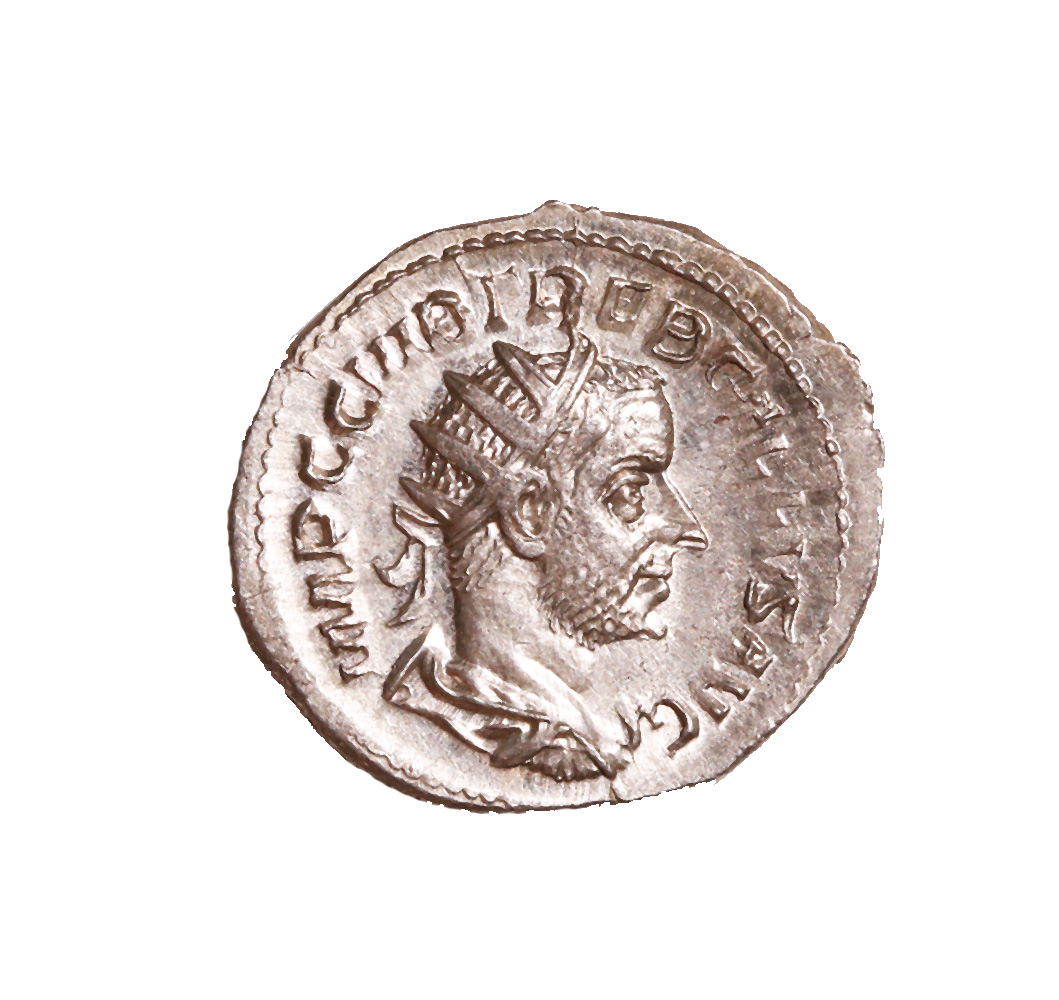
The obverse of this Antoninianus presents a bold and commanding portrait of Emperor Trebonianus Gallus facing right, radiate and draped. The radiate crown—an attribute symbolizing the sun god Sol—marks the denomination as an Antoninianus, originally valued at two denarii though by this time significantly reduced in silver content. The emperor’s portrait, executed in high relief, reveals the stylistic realism of the mid-third century: a stern expression, strong jaw, deep-set eyes, and a short-cropped beard convey the image of a pragmatic, battle-hardened ruler. The obverse legend reads “IMP C C VIB TREB GALLVS AVG,” expanding to “Imperator Caesar Caius Vibius Trebonianus Gallus Augustus,” affirming his full imperial titles. Despite the empire’s turmoil, the portrait exudes confidence and dignity, emphasizing the emperor’s legitimacy and authority. The craftsmanship of the Rome Mint engravers remains evident in the detailed rendering of facial features and the textured radiate crown, combining technical precision with a sense of stoic majesty befitting a soldier-emperor.
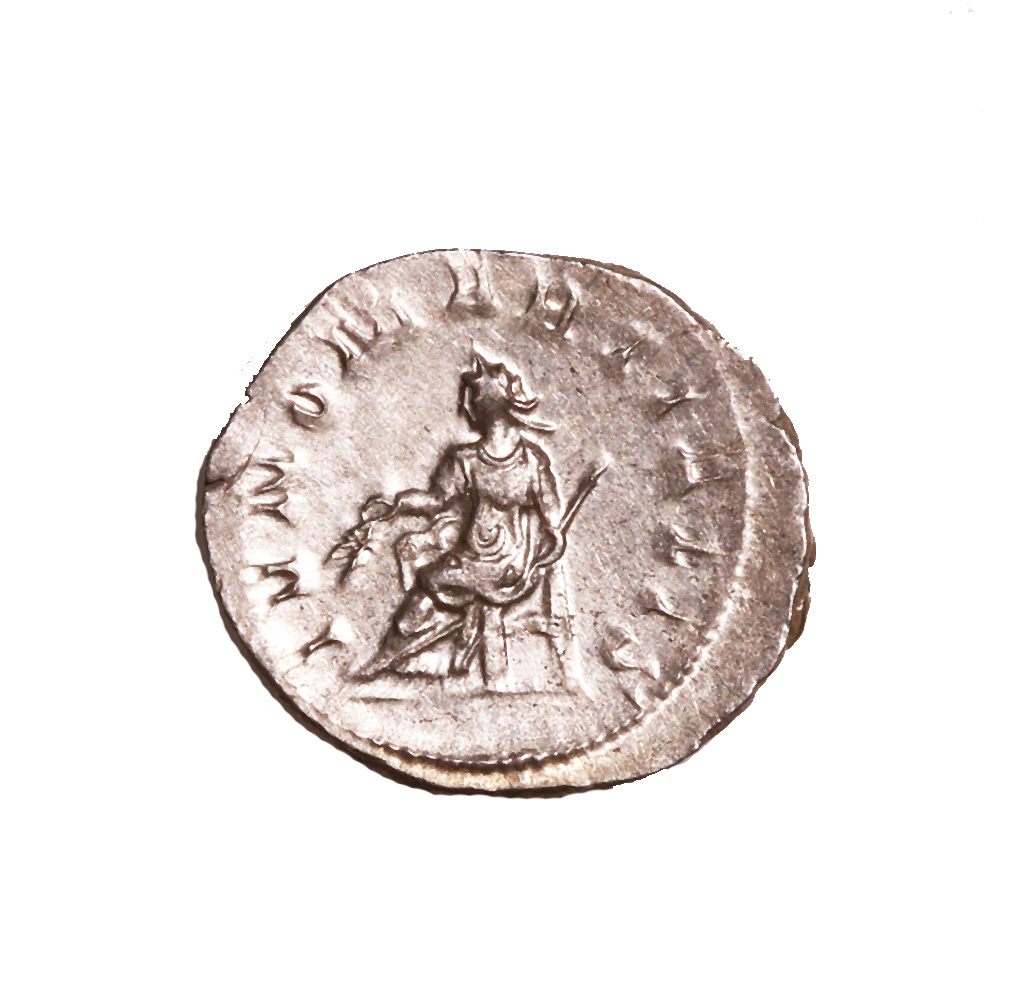
The reverse of the coin depicts Juno, queen of the gods and protector of the Roman state, standing left, holding a patera (sacrificial dish) in her right hand and a scepter in her left. At her feet often appears a peacock, her sacred bird, representing immortality and divine guardianship. The accompanying inscription, “IVNO MARTIALIS” or in some varieties simply “IVNO MARTI,” identifies the goddess in her martial or protective aspect—a fitting choice during a time of warfare and uncertainty. Juno’s imagery was frequently employed on imperial coinage to evoke stability, divine sanction, and the safeguarding of both emperor and empire. The patera symbolizes piety and ritual devotion, while the scepter underscores authority and sovereignty. The presence of Juno on Trebonianus Gallus’s coinage was a deliberate invocation of the goddess’s maternal and protective power, reminding the Roman people that, even amid crises, the empire remained under the watchful gaze of the divine matron who presided over the fortunes of the state.
The Antoninianus was struck at the Rome Mint, which remained the principal center of imperial coinage during Gallus’s reign. Despite the economic strain of the mid-third century, the mint maintained a level of technical proficiency and stylistic refinement. The coins were produced by hand-striking individual dies onto prepared silver flans, each slightly irregular in shape but carefully aligned to ensure balanced imagery. The alloy used was billon—an increasingly debased silver-copper mixture that, when freshly minted, appeared bright and silvery but eventually toned to a soft gray. During Gallus’s reign, the average silver content of Antoniniani fell to approximately 35–40%, reflecting ongoing fiscal pressures and inflation across the empire. Nonetheless, the mint’s engravers succeeded in creating coins of considerable artistic merit, especially in the detailed portraits and well-proportioned reverses that characterized this issue. The combination of high craftsmanship and declining intrinsic value makes the Antoninianus of this period a fascinating study in the contradictions of late imperial coinage.
The mintage of Trebonianus Gallus’s Antoniniani was substantial, as the emperor needed to maintain troop loyalty and finance defensive operations against both external threats and internal revolts. His coinage circulated widely across the empire, from Italy to the frontier provinces, ensuring his image was visible even in regions beset by conflict. The inclusion of Juno on the reverse served as a reassuring message to soldiers and civilians alike, emphasizing divine protection, fertility, and continuity in the face of adversity. The goddess’s symbolism would have resonated strongly in an era plagued by disease and warfare, reminding the populace that Rome’s sacred protectress had not forsaken them. The RIC-69 type, featuring Juno with the legend “IVNO MARTIALIS,” is among the most representative issues of Gallus’s reign, combining religious gravitas with elegant design. Its widespread circulation and enduring appeal underscore the importance of coinage as a tool for maintaining morale and imperial presence during the crisis of the third century.
The condition of this specimen, graded About Uncirculated (AU), highlights its exceptional preservation and fine detail. The obverse portrait of Trebonianus Gallus remains crisp and sharply struck, with the individual hair strands, laurel ties, and radiate spikes clearly visible. The facial features—particularly the eyes and beard—are deeply impressed, showing minimal flattening. On the reverse, Juno’s figure is fully intact, with the folds of her drapery finely rendered and the patera and scepter distinct. The peacock at her feet, a subtle yet significant detail, retains clear definition of its feathers and form. The legends on both obverse and reverse are bold, complete, and evenly spaced, with no weakness at the edges. The coin’s surfaces exhibit a pleasing natural silver-gray tone with faint golden iridescence, indicative of gentle aging and careful preservation. Light friction appears only on the highest points, consistent with brief circulation. The edges are well-formed and undamaged, confirming that the piece was well struck and meticulously handled since its minting.
Historically, this coin encapsulates the brief but consequential reign of Trebonianus Gallus, a ruler who inherited an empire already reeling from external invasions and internal strife. Following the death of Decius, Gallus initially secured peace with the Goths by allowing them to withdraw with their plunder, a decision that, while pragmatic, damaged his reputation among Roman elites. Simultaneously, the empire was ravaged by the so-called Cyprian Plague, a pandemic that decimated the population and further strained the economy. Against this backdrop, the imagery of Juno on coinage assumed even greater significance. As the divine guardian of the Roman state and motherhood, Juno represented endurance and hope, qualities desperately needed during Gallus’s embattled rule. The “Juno Martialis” aspect emphasized the goddess’s protective power over Rome’s armies, aligning her divine strength with the emperor’s efforts to defend the empire’s frontiers. Thus, this coin’s iconography reflects not only religious devotion but also the emperor’s attempt to associate his rule with divine favor and stability amid chaos.
Economically, the Antoninianus of this period provides key insight into the deteriorating fiscal health of the Roman Empire. The gradual debasement of the silver coinage mirrored the inflation and monetary strain caused by constant warfare and plague-related disruptions. Despite this, the artistry and propaganda value of coins remained undiminished, demonstrating that even in crisis, Rome continued to assert its cultural sophistication and imperial identity through its currency. The Antoninianus, with its larger size and radiate portraits, maintained symbolic grandeur, even as its intrinsic value declined. Its widespread circulation throughout the provinces ensured that the emperor’s image—and by extension, imperial legitimacy—remained omnipresent, reinforcing loyalty through visibility.
From a numismatic standpoint, the AR Antoninianus of Trebonianus Gallus (RIC-69 “Juno Martialis”) is an exceptional representation of the artistry and political messaging of the mid-third century. The combination of a forceful imperial portrait and a classically composed reverse type evokes both strength and divine protection. Collectors and historians alike prize this type for its clarity of design, fine preservation, and the historical resonance of its imagery. In About Uncirculated condition, the coin retains nearly all its original detail and luster, offering a vivid glimpse into the craftsmanship of Rome’s mints during one of the empire’s most challenging eras. It stands as a silver-gray testament to the enduring resilience of Roman civilization—an artifact born in crisis but preserved in beauty, bridging the world of imperial grandeur with the fragility of empire itself.


