
- home
- Ancient Coins
- Ancient Roman Coins
- Roman Empire AR Antoninianus Otacilia Severa 245-247 A.D. RIC-125 Concordia AU
- Back to:
- Ancient Roman Coins


Roman Empire AR Antoninianus Otacilia Severa 245-247 A.D. RIC-125 Concordia AU
| Qty | Wire/Check | Bitcoin | CC/Paypal |
| Any | $195.00 | $196.95 | $202.80 |
The Roman Empire AR Antoninianus of Otacilia Severa, struck between 245 and 247 A.D. and catalogued as RIC-125, is a remarkable silver coin that embodies the elegance, virtue, and political significance of the empress during the reign of her husband, Emperor Philip I “the Arab.” As Augusta, Otacilia Severa played a crucial role in projecting an image of harmony and legitimacy during a time of growing political tension within the empire. This Antoninianus, a denomination introduced only a few decades earlier by Caracalla, served not only as a medium of exchange but also as a key instrument of imperial propaganda. The coin’s obverse proclaims the dignity and piety of the empress, while its reverse, depicting the goddess Concordia, symbolizes the unity and stability that the imperial household sought to present to Rome’s people and provinces. Struck in fine silver, this coin is a testament to the craftsmanship, ideology, and historical importance of mid-third-century Roman numismatics.
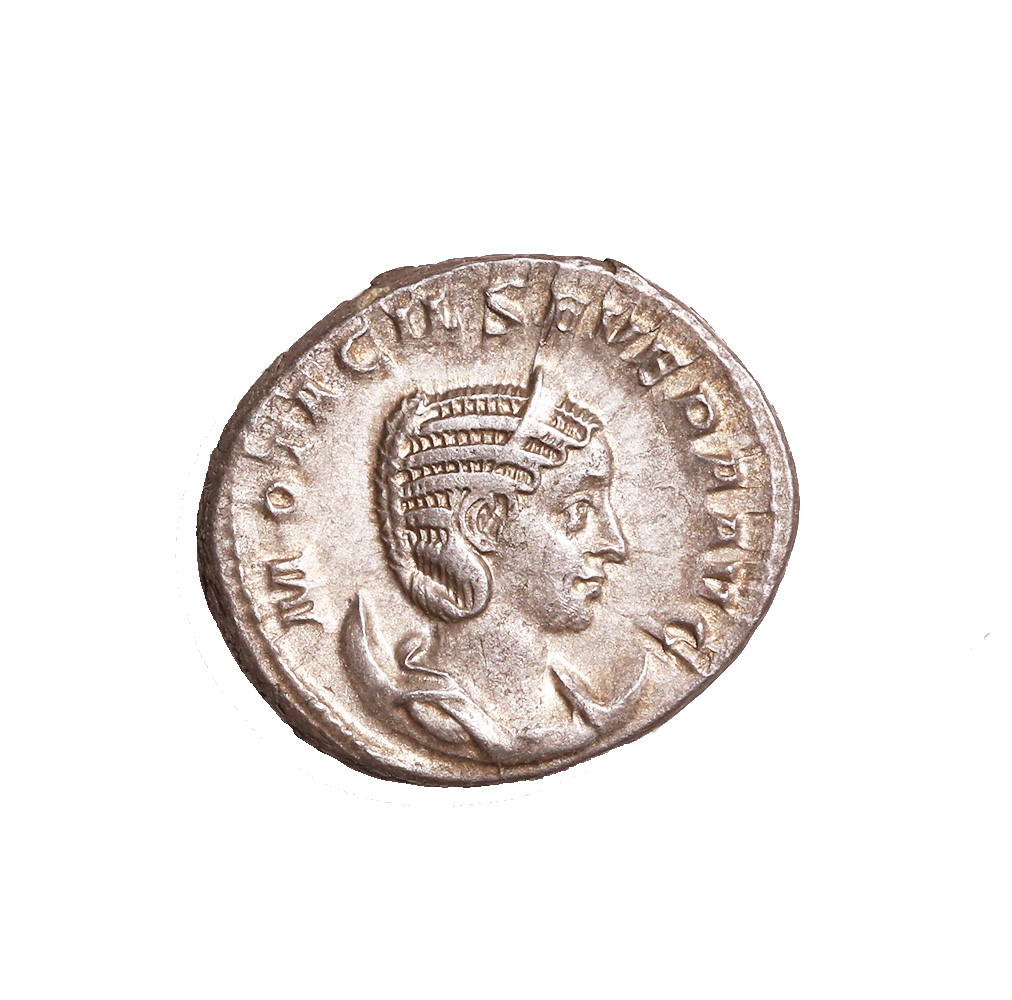
The obverse of the Antoninianus displays a beautifully engraved bust of Otacilia Severa facing right, wearing the radiate crown characteristic of the denomination. The radiate crown, originally associated with the sun god Sol, symbolized the divine light of the imperial office, distinguishing the Antoninianus from the smaller silver denarius. The empress is shown draped, with her hair elegantly styled in the intricate waves and coils fashionable among Roman noblewomen of the period. Her serene expression and finely modeled features convey dignity, grace, and the modesty expected of an imperial consort. The obverse legend reads “M OTACIL SEVERA AVG,” expanding to “Marcus Otacilia Severa Augusta,” clearly identifying her as the reigning empress. The artistry of the portrait is noteworthy—though idealized, it conveys a sense of personality and poise, consistent with Otacilia’s historical reputation as a virtuous and intelligent woman. The obverse thus serves both as a portrait of the living empress and as an embodiment of the moral ideals associated with Rome’s imperial women.
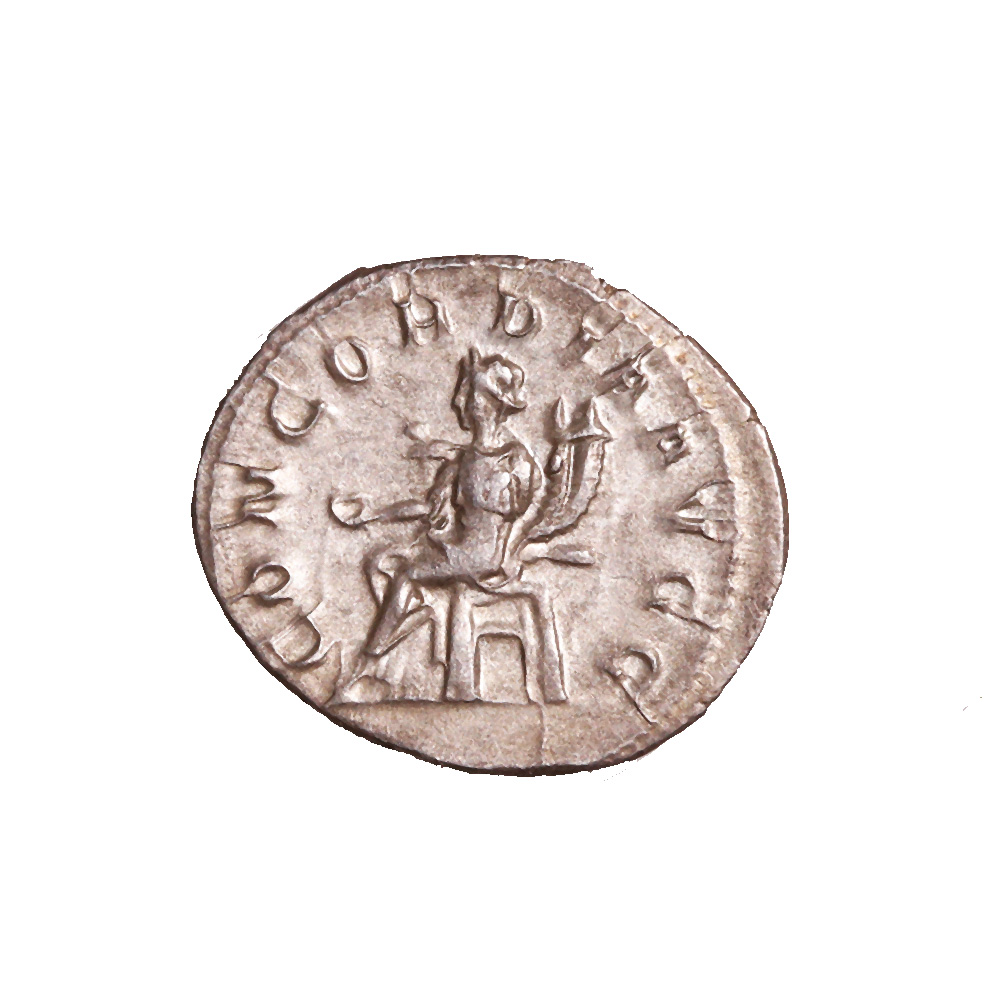
The reverse type of RIC-125 features the goddess Concordia seated left, holding a patera (offering dish) in her right hand and a double cornucopia in her left. The accompanying legend, “CONCORDIA AVGG,” translates to “The Harmony of the Augusti,” referring to the unity between the emperor and empress as well as the broader harmony of the imperial household and state. Concordia, a long-standing personification of agreement and mutual understanding, was a favorite symbol on the coinage of empresses, particularly in times when the imperial family wished to emphasize stability amid potential unrest. The cornucopia represents abundance and prosperity, while the patera signifies piety and divine favor. The seated posture of Concordia conveys calmness and permanence, virtues that the Severan and later dynasties associated with female imperial influence. This reverse design not only honored the empress’s role as moral compass and peacemaker but also reassured the empire’s subjects of the political unity between Philip and Otacilia during a volatile period of military and economic uncertainty.
The Antoninianus itself was introduced around 215 A.D. as a double-denarius coin, though by the time of Otacilia Severa’s reign, its silver content had been significantly reduced to around 40–50%. Despite debasement, the coin remained visually impressive, with bright surfaces when freshly struck. The flans were typically broad and thin, averaging 22–24 millimeters in diameter and 3.5–4.5 grams in weight. The coin was struck at the Rome Mint, the empire’s central production facility, which maintained a high standard of engraving and design during Philip I’s reign. Each die was individually engraved, resulting in subtle variations between specimens. The radiate crown of the empress and the balanced composition of the reverse exemplify the sophisticated aesthetic of the Roman mint at mid-century, even as the empire faced growing internal pressures. The silvered appearance of these coins—sometimes enhanced by surface silvering—gave them a brilliance that symbolized imperial splendor and divine authority, despite the declining intrinsic value of the metal.
The mintage of Otacilia Severa’s Antoniniani was extensive, reflecting her prominence as Augusta and the empire’s emphasis on dynastic imagery. Coins bearing her likeness circulated widely throughout the Roman provinces, often appearing alongside those of Philip I and their young son, Philip II. This coordinated coinage program underscored the legitimacy of the imperial family, presenting them as a harmonious and divinely favored trinity of rulers. The Concordia reverse, in particular, was produced in significant numbers during 245–247 A.D., a period of relative peace following Philip’s settlement with the Persians and his preparations for Rome’s upcoming millennium celebrations in 248 A.D. The use of Concordia as a motif likely alluded to the emperor’s efforts to maintain domestic unity and moral order, while also honoring the empress’s influence in fostering loyalty and stability within the court. As a result, the coin functioned as both currency and propaganda, circulating throughout the empire as a tangible emblem of imperial harmony.
The condition of this particular specimen, graded About Uncirculated (AU), is superb for a mid-third-century silver issue. The obverse portrait of Otacilia Severa remains sharply struck, with crisp detail visible in the radiate crown, facial features, and elaborate coiffure. The legends are complete and deeply impressed, showing no signs of weakness or die wear. The reverse image of Concordia is equally well-preserved: the seated figure retains clear definition in her drapery, cornucopia, and patera, while the legend “CONCORDIA AVGG” is bold and legible. The coin exhibits a bright, even silver-gray luster with subtle iridescent toning, indicative of its original metallic composition and careful preservation. Only slight wear appears on the highest points of the design, consistent with brief circulation. The fields are smooth and reflective, free from corrosion or significant marks, and the edges remain intact with a well-centered strike. Such preservation is exceptional for an Antoninianus of this era, as most surviving examples display heavy wear or surface degradation due to circulation and debasement.
Historically, the coin reflects the character and political role of Otacilia Severa herself. Born into an aristocratic family of Syrian or Roman origin, she married Philip around 234 A.D. and became Augusta upon his accession in 244 A.D. Contemporary sources and numismatic evidence alike portray her as a cultured and benevolent empress, devoted to family, religion, and the empire’s welfare. Unlike many of her predecessors, Otacilia was not associated with scandal or intrigue; instead, she was revered for her modesty and charitable nature. Her association with Concordia on coinage underscores this reputation, aligning her with the goddess of harmony in both domestic and civic life. The image of Concordia holding symbols of plenty and piety mirrored Otacilia’s perceived virtues, reinforcing her status as the ideal imperial consort during a period when moral and political cohesion were critical to the empire’s survival.
The years 245–247 A.D. were significant in Roman history, as Philip the Arab sought to consolidate his authority after the brief reign of Gordian III and prepare for Rome’s millennial celebration in 248. The empire, though stable on the surface, faced mounting challenges along its frontiers and increasing financial strain. In this context, Otacilia’s image on coinage provided reassurance of continuity, feminine virtue, and divine favor. The recurring theme of Concordia on her coins symbolized not only the unity of the imperial couple but also the broader harmony between emperor, Senate, and people—an ideal that the regime sought to maintain amid growing instability. Through this iconography, Otacilia’s Antoninianus served as a moral and political statement, linking the prosperity of the empire to the virtue of its rulers and the favor of its gods.
From a numismatic perspective, the AR Antoninianus of Otacilia Severa (RIC-125 “Concordia”) represents one of the most refined examples of third-century Roman portraiture and symbolism. The combination of her dignified obverse portrait and the elegant reverse design captures both the artistry and ideology of the mid-imperial period. Collectors value this type not only for its aesthetic appeal but also for its historical importance as a reflection of an empress whose image embodied peace, virtue, and balance during a time of transition. In About Uncirculated condition, the coin retains nearly all of its original beauty, offering a glimpse into the skill of the Roman mint and the enduring legacy of imperial women in Roman art and statecraft. It stands as both a masterpiece of ancient coinage and a silver tribute to the grace and harmony that Otacilia Severa brought to the Roman world at the height of her influence.


