
- Back to:
- France World Coins


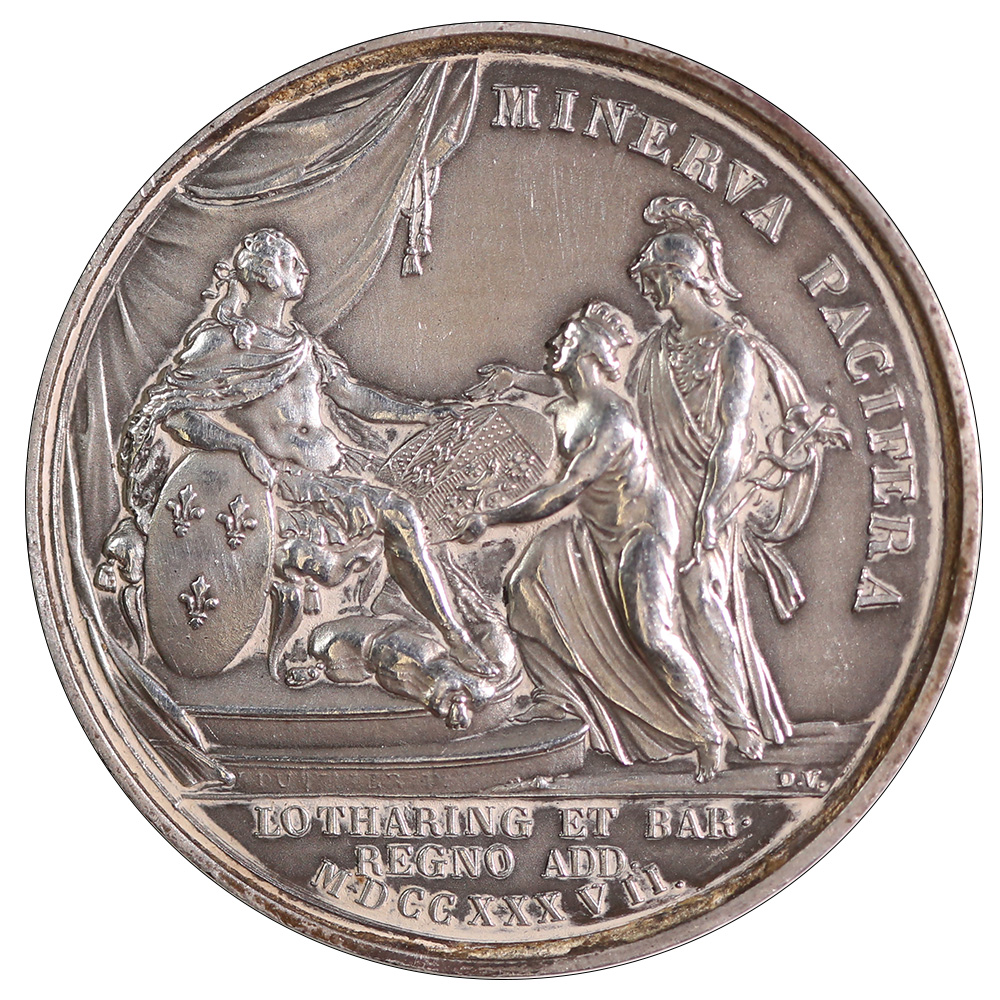
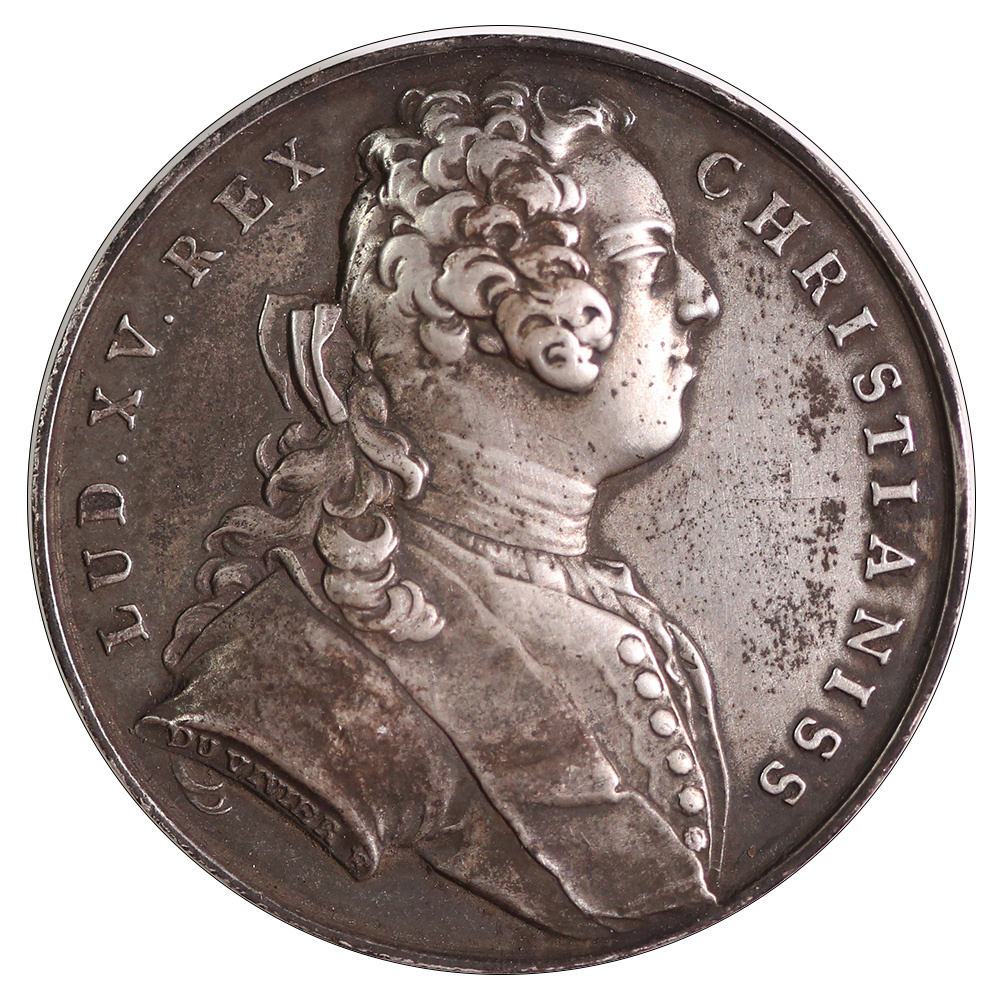
France 40mm Silver Medal 1737 Louis XV Minerva Pacifera
| Qty | Wire/Check | Bitcoin | CC/Paypal |
| Any | $249.00 | $251.49 | $258.96 |
The France 40mm Silver Medal 1737 Louis XV Minerva Pacifera is a masterful example of eighteenth-century French medallic art, capturing both the political aspirations and neoclassical elegance of the reign of Louis XV. Struck in 1737, this medal commemorates France’s pursuit of peace and prosperity during a period of transition in European affairs, with Minerva—the Roman goddess of wisdom, strategy, and the arts—serving as a symbolic embodiment of France’s enlightened governance and cultural refinement. Crafted in fine silver and measuring approximately 40 millimeters in diameter, this medal was issued under the direction of the Paris Mint, one of Europe’s preeminent centers of engraving and die work. It reflects not only the high artistry of French medalists under royal patronage but also the broader intellectual and diplomatic climate of the early eighteenth century, when France sought to balance military strength with diplomacy following decades of war under Louis XIV.
The obverse of the 1737 Louis XV Minerva Pacifera medal features a finely detailed bust of King Louis XV facing right, rendered in the elegant baroque style typical of the early decades of his reign. The young monarch is portrayed in armor, draped with a richly engraved cloak, and adorned with the Order of the Holy Spirit cross upon his chest—a mark of royal dignity and France’s most esteemed chivalric order. His hair, arranged in flowing curls, reflects both fashion and majesty, emphasizing the continuity of the Bourbon line. The Latin inscription surrounding the portrait reads “LUDOVICUS XV REX CHRISTIANISSIMUS,” translating to “Louis XV, Most Christian King,” a traditional royal title affirming France’s role as the eldest daughter of the Church. The obverse engraving is distinguished by delicate shading and fine linear detail, typical of the work of the great medalists of the Paris Mint during this era, such as Jean Dassier or his French contemporaries. The precise artistry of the bust conveys both regal serenity and youthful authority, reflecting Louis XV’s reputation as “Le Bien-Aimé,” the beloved king.
The reverse design of the medal, bearing the legend “MINERVA PACIFERA,” is a powerful allegorical statement that translates to “Minerva, the Bringer of Peace.” Minerva, the goddess of wisdom and strategic warfare, stands gracefully at the center, holding an olive branch in one hand and a spear in the other—symbols of peace tempered by readiness for defense. She is depicted in classical armor, with a plumed helmet and a flowing robe that falls naturally across her form. At her feet rests a shield, often emblazoned with a French fleur-de-lis or other royal emblem, indicating that she acts in service to France. In the background, instruments of war—such as cannons, drums, and flags—lie discarded or at rest, symbolizing the triumph of peace over conflict. The exergue below the main design often carries the date “MDCCXXXVII” (1737) in Roman numerals. The overall composition conveys a message of intellectual strength, civic order, and the virtuous pursuit of stability following the long years of European wars that had defined the previous reign.
The Minerva Pacifera type was part of a series of royal medals struck under the direction of the French Académie des Inscriptions et Belles-Lettres, which oversaw the creation of official medals documenting the events and virtues of the Bourbon monarchy. These medals served both commemorative and propagandistic purposes, celebrating the cultural and political ideals of the crown while also showcasing France’s artistic leadership. The Paris Mint, operating under royal authority, produced these medals in gold, silver, and bronze, with silver examples like this one representing a balance between beauty and accessibility for dignitaries and collectors. The quality of striking and engraving on such pieces was exceptionally high, with attention to texture, relief depth, and finish, ensuring that each medal stood as both an historical record and an object of art.
The year 1737 marked a relatively peaceful moment in the reign of Louis XV, following the Treaty of Vienna in 1735 that ended the War of the Polish Succession (1733–1735). The treaty had reaffirmed France’s influence in Europe while restoring a degree of continental stability. The Minerva Pacifera medal, likely issued shortly thereafter, celebrates this peace and the wisdom of French diplomacy that achieved it. The image of Minerva was a deliberate choice, aligning France with the virtues of intellect, prudence, and civilization, rather than mere martial conquest. In this way, the medal reflects the Enlightenment ideals that were beginning to shape European thought—emphasizing knowledge, reason, and the arts as instruments of national greatness.
The medal was almost certainly engraved and struck at the Hôtel de la Monnaie in Paris, which by the early eighteenth century had become renowned for the precision and artistry of its medals and jetons. Medals like this one were often distributed to courtiers, foreign dignitaries, and scholars, or retained in royal collections that documented the major events of each reign. Some examples were struck as proofs or presentation pieces in high-relief silver, showcasing the dies at their sharpest and most detailed. The silver composition ensured durability and provided a pleasing contrast between the lustrous surfaces and the frosted devices, accentuating the fine engraving. Edge markings, when present, may include a plain or lettered edge, depending on the striking method, and some pieces carry the signature of the engraver or mint official along the truncation of the bust.
The 40mm diameter of the medal gives it a commanding presence, allowing for the inclusion of rich detail without overcrowding the design. The medal’s balanced proportions and precise engraving demonstrate the Paris Mint’s mastery of medallic art during the eighteenth century, a period when French craftsmanship set the standard across Europe. The surfaces of surviving silver examples typically exhibit gentle toning, with hues of gold, gray, and blue developing naturally over nearly three centuries, enhancing the medal’s aesthetic appeal. Examples that retain sharp relief and original luster are particularly prized among collectors. Minor surface marks or light hairlines may be present but are considered natural signs of age rather than flaws.
In terms of rarity and numismatic importance, the 1737 Louis XV Minerva Pacifera silver medal occupies a prominent place within the corpus of French royal medals. While not as widely distributed as bronze strikes, silver examples were often produced in smaller quantities and intended for presentation to important figures. Surviving specimens demonstrate the high standard of die engraving and striking precision characteristic of the Paris Mint’s output in the first half of the eighteenth century. The combination of historical context, artistic mastery, and precious metal composition makes this medal particularly desirable to collectors of French royal memorabilia and early European art medals.
The condition and preservation of a 1737 Minerva Pacifera medal significantly influence its value. Well-preserved examples display even patina, strong definition in Minerva’s figure and Washington’s bust, and clear legibility of the Latin inscriptions. Light cabinet friction on the highest points is common and acceptable, while deep toning or iridescent hues can enhance the coin’s aesthetic presence. Collectors often prize the medal’s balance of political symbolism and artistic grace, appreciating it as both a historical artifact of diplomacy and a fine specimen of neoclassical design.
The France 40mm Silver Medal 1737 Louis XV Minerva Pacifera stands today as a testament to the artistic brilliance and diplomatic ideals of eighteenth-century France. It embodies the refinement of the Bourbon monarchy, the skill of the Paris Mint engravers, and the intellectual transformation that shaped European culture during the Enlightenment. Through its depiction of Minerva as the peaceful guardian of civilization, the medal immortalizes the French vision of enlightened kingship—one that valued wisdom, beauty, and harmony as the true foundations of royal greatness. As a result, it remains a centerpiece in collections of French historical medals, admired equally for its artistry, symbolism, and historical depth.


