
- Back to:
- U.S. Medals


U.S. Mint Washington Centenary Medal 1904--Master Mason 40mm
| Qty | Wire/Check | Bitcoin | CC/Paypal |
| Any | $149.00 | $150.49 | $154.96 |
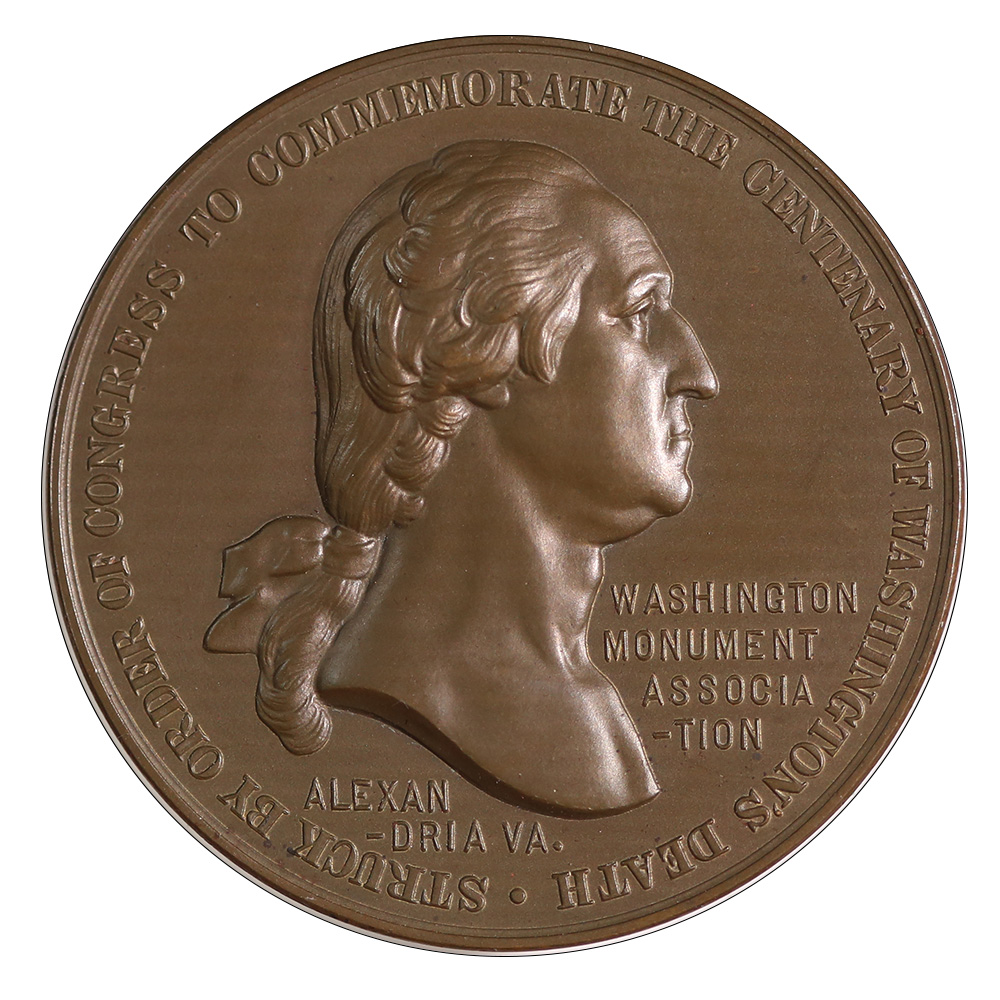
The U.S. Mint Washington Centenary Medal 1904—Master Mason 40mm is an exquisite bronze medal struck by the United States Mint in Philadelphia to commemorate the 100th anniversary of George Washington’s death and to honor his enduring influence as a Freemason and national figure. Issued in 1904, this 40-millimeter piece embodies the craftsmanship and symbolism characteristic of early twentieth-century American medallic art. While several variations of the 1904 Washington Centenary Medal exist, this particular edition—engraved “Master Mason”—was created specifically for Masonic lodges and members to commemorate Washington’s deep connection with Freemasonry. Combining the imagery of national reverence with Masonic allegory, the medal serves as both a patriotic tribute and a personal emblem of fraternity, virtue, and enlightenment.
George Washington’s association with Freemasonry was a central part of his public image and personal philosophy. Initiated into Fredericksburg Lodge No. 4 in Virginia in 1752, he later served as Worshipful Master of Alexandria Lodge No. 22, one of the most historic lodges in American Masonic history. The 1904 Master Mason medal was thus issued not merely to celebrate Washington as a statesman but to honor his moral and fraternal legacy as a Mason—an embodiment of brotherhood, honor, and integrity. The centenary referenced by this medal corresponds to a century after his passing in December 1799, with formal celebrations held by lodges across the United States in the years surrounding the 1900s, marking one hundred years since his Masonic contributions and the century of American independence he helped found.
The obverse of the medal features a finely modeled profile portrait of George Washington facing left, rendered in high relief and based on the classical neoclassical bust by Jean-Antoine Houdon—the most faithful likeness of the first president. His expression is dignified yet serene, reflecting his role as both a leader and a man of principle. Around the periphery runs the inscription “GEORGE WASHINGTON CENTENARY 1904,” or a variant reading “WASHINGTON CENTENARY,” depending on the striking. The engraving style reflects the formal precision of the U.S. Mint’s chief engravers of the period, such as Charles E. Barber or George T. Morgan, whose influence can be seen in the fine line work and balanced design. The obverse surface is smooth and evenly finished, creating a strong contrast between the raised portrait and the fields, while the edges of the bust display clear, detailed modeling consistent with Mint-issued medal standards.
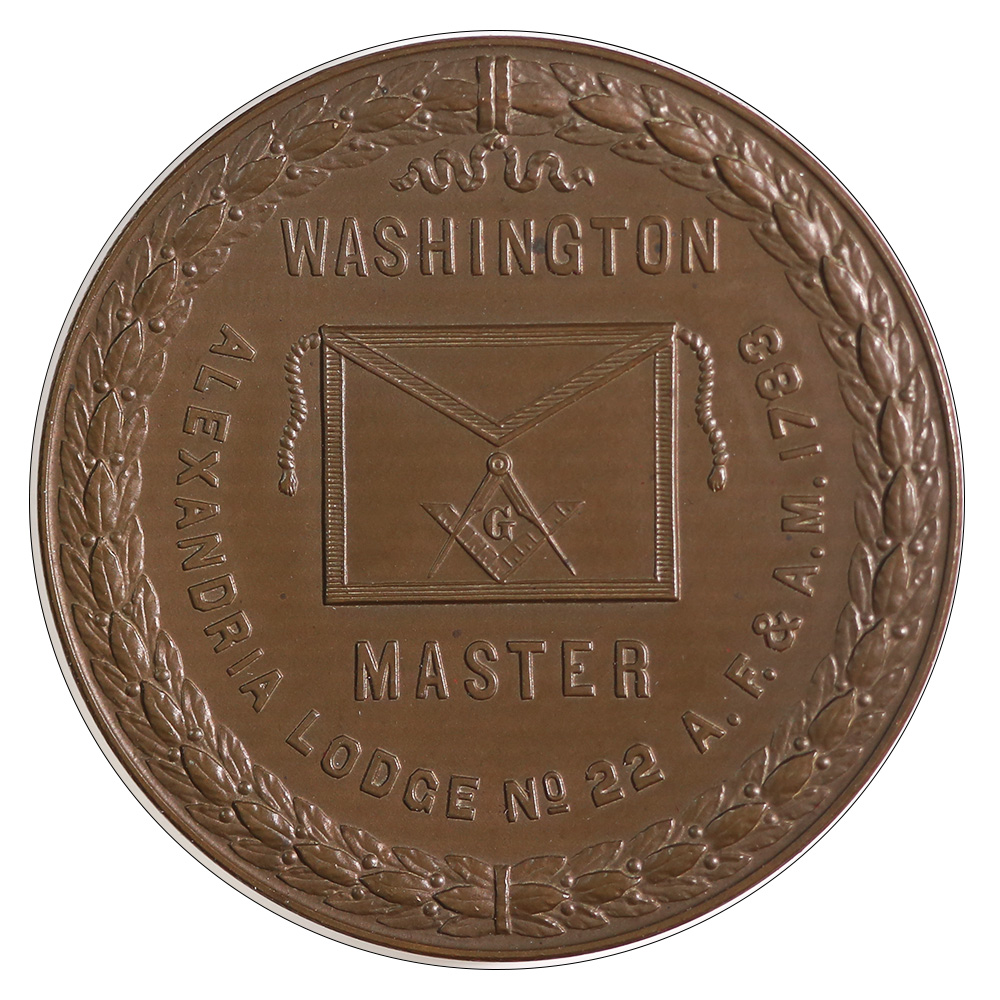
The reverse design is what distinguishes this specific “Master Mason” variety from other Washington centenary medals. At its center appears a Masonic emblem—typically the square and compasses with the letter “G” within, symbolizing geometry, guidance, and God, the Great Architect of the Universe. Surrounding the central device is the inscription “MASTER MASON,” prominently placed in bold serif lettering. Additional decorative elements, such as laurel branches or beaded borders, often frame the composition, signifying achievement, fraternity, and virtue. On some examples, the words “In Commemoration of the Centenary of George Washington” are added around the perimeter, uniting the Masonic symbolism with the historical theme. The reverse engraving combines both solemnity and elegance, striking a balance between commemorative beauty and symbolic meaning.
The production of this medal was undertaken by the United States Mint at Philadelphia, which by 1904 had become a leading producer of official medals for government institutions, patriotic societies, and fraternal organizations. The Mint’s engravers utilized high-grade bronze planchets, polished dies, and a medallic striking process that ensured deep, sharp relief and even coloration. At 40 millimeters in diameter, the piece is of substantial size, allowing ample room for fine detail without overcrowding. The edge of the medal may be plain or marked with the Mint’s identifying stamp, depending on the striking batch. The consistent quality and precision of the Mint’s work during this era made such medals sought-after presentation items, often distributed to dignitaries, lodge officers, or members attending commemorative events.
The creation of the 1904 Washington Centenary “Master Mason” medal coincided with a period of renewed public interest in the life and moral example of George Washington. The late nineteenth and early twentieth centuries saw numerous historical and Masonic celebrations dedicated to his legacy, particularly as Freemasonry itself experienced a period of growth in membership and public visibility. This medal served as both a commemorative object and a symbol of unity among Masonic brethren, connecting the principles of the fraternity—brotherly love, relief, and truth—with the virtues of the nation’s founding leader. Many were presented during ceremonies or anniversary gatherings, where they were treasured as keepsakes rather than worn.
The mintage of the 1904 Master Mason Washington Centenary Medal was limited, as these medals were not released for public circulation but distributed primarily through Masonic lodges and regional Grand Lodges. Surviving examples are relatively scarce, particularly those retaining their original mint surfaces. While no exact production figures are known, numismatic records and Masonic archives suggest that production was small—perhaps several hundred to a few thousand pieces—depending on demand among lodges at the time. Because of their targeted issuance and personalized inscriptions, surviving specimens often carry slight die or engraving variations, making them of additional interest to collectors of Masonic memorabilia and U.S. Mint medals alike.
The condition of existing examples typically ranges from Extremely Fine to Mint State, with high points showing only light cabinet friction. Well-preserved pieces display smooth chocolate-brown bronze surfaces with subtle golden highlights on the raised relief, particularly around Washington’s profile and the Masonic emblems. The sharp edges and clear lettering attest to the medal’s strong strike quality, while the absence of corrosion or cleaning marks adds considerably to its desirability. Over time, many examples have developed rich, even patina, a feature often prized for its depth and aesthetic warmth. Prooflike examples—those with mirrored fields and frosted devices—were likely struck as special presentation pieces and command the greatest collector interest.
Symbolically, the 1904 Washington Centenary Master Mason medal holds a dual significance. For Masons, it represents a direct link to their most venerated brother—a man whose leadership, humility, and adherence to moral principle embodied the fraternity’s ideals. For numismatists and historians, it captures the craftsmanship and civic pride of the early twentieth-century U.S. Mint, a period when medals were struck not merely as commemoratives but as artistic expressions of national identity. The combination of fine engraving, Masonic symbolism, and historical context makes this piece a meaningful intersection between American history and the traditions of Freemasonry.
Today, the U.S. Mint Washington Centenary Medal 1904—Master Mason 40mm is regarded as a distinguished artifact of both numismatic and fraternal heritage. Its dignified portrait of Washington, coupled with its Masonic reverse, reflects the ideals of wisdom, service, and unity that he personified. Collectors prize it for its artistry, rarity, and historical resonance, while Masonic lodges continue to view it as a cherished symbol of continuity with the fraternity’s greatest exemplar. As a tangible link between the early republic, the Masonic brotherhood, and the golden age of American medallic engraving, this medal endures as a testament to the timeless virtues of honor, craftsmanship, and enlightenment.


