
- Back to:
- U.S. Medals


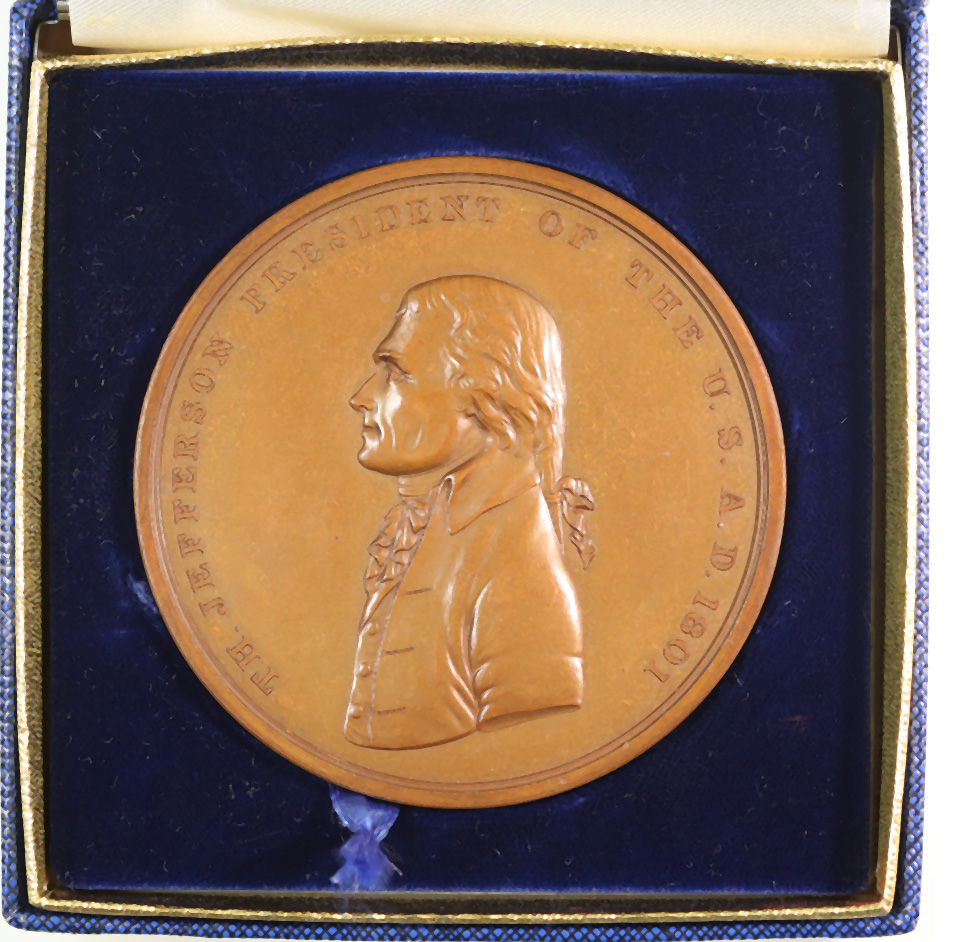
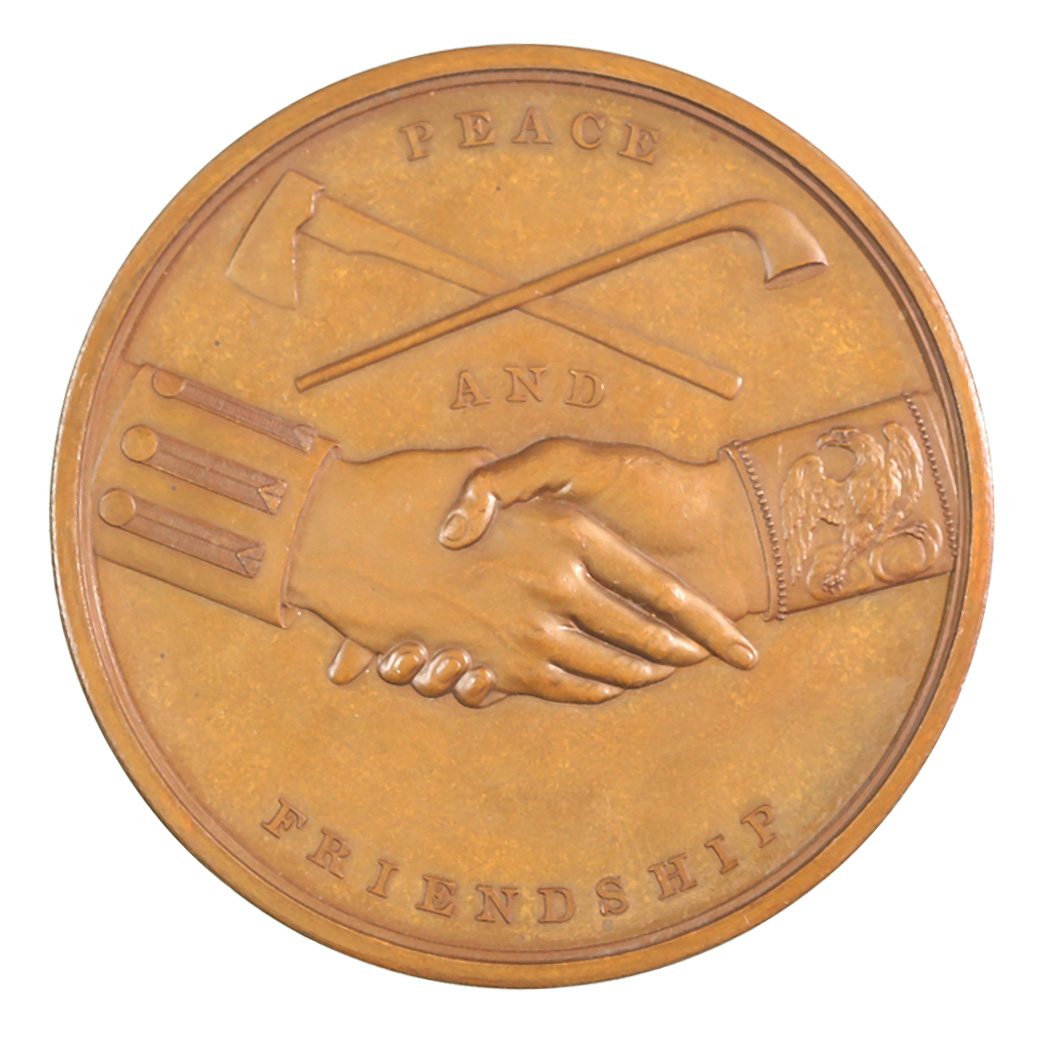
U.S. Mint Bronze Medal 3" 1801 Jefferson Peace Medal Restrike
| Qty | Wire/Check | Bitcoin | CC/Paypal |
| Any | $450.00 | $454.50 | $468.00 |
The U.S. Mint Bronze Medal 3" 1801 Jefferson Peace Medal Restrike is one of the most admired pieces in the official U.S. Mint medallic series, commemorating the presidency of Thomas Jefferson and his role in early American diplomacy. This large bronze medal is a faithful restrike of the original silver Jefferson Indian Peace Medal first issued in 1801, a design historically presented to Native American leaders as a gesture of friendship and alliance. Struck in high-relief bronze and measuring 3 inches in diameter, the modern restrike embodies the neoclassical artistry of the early 19th century while preserving the deep historical meaning of the original issue. The Jefferson Peace Medal holds a central place in U.S. numismatic and cultural heritage, symbolizing the country’s early efforts to foster peaceful relations, trade, and mutual respect with Native tribes on the expanding American frontier. The U.S. Mint’s restrike faithfully captures the elegance and symbolism of the original medal, allowing modern collectors to own a tangible connection to one of the earliest and most historically resonant artifacts of American diplomacy.
The obverse of the Jefferson Peace Medal features a dignified portrait of Thomas Jefferson facing left, rendered in exquisite neoclassical style. His profile, framed by soft curls of hair and a draped coat collar, exudes calm intelligence and moral authority—traits for which Jefferson was revered both as statesman and scholar. Surrounding the portrait is the Latin inscription “TH. JEFFERSON PRESIDENT OF THE U.S. A.D. 1801,” signifying the year he assumed the presidency. The simple, elegant lettering complements the refined style of the engraving, which was the work of John Reich, a talented Mint engraver of German origin. The design is notable for its restraint and balance, emphasizing Jefferson’s thoughtful demeanor rather than pomp or decoration. On the large 3-inch bronze format, every detail of the engraving is amplified—the texture of the hair, the modeling of the face, and the crispness of the inscriptions—creating a striking visual presence worthy of America’s third president and author of the Declaration of Independence.
The reverse of the medal carries one of the most iconic and symbolically rich designs in early American medallic art. It depicts two clasped hands—one representing an American soldier, the other a Native American—joined in a gesture of friendship and peace. The cuff of the left hand bears three buttons and an engraved cuff link inscribed “U.S.A.,” representing the American government, while the right hand is adorned with a simple beaded wristband, signifying a Native ally. Above the hands appears a crossed tomahawk and peace pipe, emblematic of the choice between war and peace, while the inscription “PEACE AND FRIENDSHIP” arcs across the top. The symbolism of this design, both elegant and profound, captures the spirit of Jefferson’s policy toward Native tribes during his presidency: the desire to secure peaceful coexistence, trade, and alliance through diplomacy rather than conquest. The imagery would later become a defining emblem of America’s westward expansion, reproduced on medals presented during Lewis and Clark’s expedition and throughout the 19th century.
The origin of the Jefferson Peace Medal lies in one of the most fascinating episodes of early U.S. diplomacy. When Jefferson took office in 1801, he sought to strengthen relations with Native American nations as the United States expanded westward beyond the Mississippi. Peace medals bearing the president’s likeness were commissioned by the U.S. Mint in Philadelphia and distributed by government agents, explorers, and traders to tribal chiefs as symbols of friendship and alliance. The medals were regarded as diplomatic gifts, representing not only goodwill but also the authority and promise of the American government. They often played crucial roles in negotiations, trade agreements, and peace councils. Jefferson’s medals were among the earliest examples, and their design—with its joining of hands and message of peace—became the prototype for all subsequent presidential Indian Peace Medals. Larger silver versions were presented to high-ranking chiefs, while smaller ones went to lesser leaders. The presentation of these medals continued well into the late 19th century, making them enduring symbols of early American diplomacy and frontier relations.
The U.S. Mint’s bronze restrike program, established in the mid-20th century, was created to preserve the designs of America’s historical medals for collectors and educational institutions. The 3-inch Jefferson Peace Medal restrike is among the most admired in this series, faithfully struck from dies that replicate the originals used in 1801. Each piece is struck in solid bronze with high-relief detail, showcasing the engraving’s fine lines and the rich symbolism of the clasped hands motif. The medal typically weighs around 180–200 grams and exhibits a warm reddish-brown patina that enhances its depth and dimension. The edges are smooth and inscribed “U.S. MINT,” confirming authenticity and origin. The precision of the restrike process ensures that every detail—the facial expression, inscriptions, and intricate hand textures—is reproduced with fidelity to the original. The large size allows the design to be appreciated as both a work of art and a document of American history, reflecting the neoclassical sensibility that dominated early 19th-century government art.
The artistry of the Jefferson Peace Medal reflects the ideals of neoclassicism, emphasizing clarity, proportion, and moral dignity. The portrait of Jefferson is both realistic and idealized, portraying the president not merely as a political leader but as a philosopher-statesman in the mold of Enlightenment thought. The clasped hands on the reverse are rendered with remarkable subtlety—the contrast between the cuffed sleeve and the beaded wrist captures both cultural difference and mutual respect. The crossed tomahawk and pipe above serve as moral emblems of human choice, inviting reflection on peace as a voluntary, honorable act. These design choices demonstrate how American medallic art from this era sought to express the young nation’s principles through universal classical symbolism. The same aesthetic that inspired the Jefferson Peace Medal would influence U.S. coinage for generations, culminating in later designs such as the 1907 Saint-Gaudens $20 gold coin, which also balanced artistic beauty with civic ideals.
The mintage of the 3-inch bronze Jefferson Peace Medal restrike is relatively limited, as these medals are produced primarily for collectors and museums through the U.S. Mint’s Historical Medals program. While thousands of the smaller 1.5-inch versions exist, the large-format 3-inch editions are far scarcer and highly valued for their imposing presence and exceptional detail. Each medal was struck individually on high-tonnage presses to ensure clean, sharp impressions and then carefully finished to achieve the rich patina that distinguishes U.S. Mint bronze medals. The Mint has periodically reissued this design in small quantities since the 1970s, often sold directly to collectors or educational institutions, making each generation of restrikes part of a continuing lineage of preservation. Though not legal tender, these medals hold intrinsic value as tangible works of American art and historical continuity.
The condition of this example, graded About Uncirculated to Uncirculated, attests to its excellent preservation. The surfaces retain full mint luster with deep, even bronze coloration and a satiny finish that enhances the three-dimensional quality of the design. Under close inspection, the fine engraving details—particularly the lines in Jefferson’s hair and the texture of the clasped hands—remain sharp and unworn. The fields are smooth, showing only the faintest signs of handling or toning that accompany long-term storage. The edges are clean, and the rim is free from dents or discoloration. The even patina gives the medal an appearance of quiet antiquity while preserving its brilliance, making it suitable for both display and scholarly study. In this grade, the medal represents an outstanding example of modern craftsmanship in the service of historical remembrance.
Historically, the Jefferson Peace Medal restrike connects collectors directly to a defining moment in early U.S. history—the intersection of diplomacy, exploration, and national identity. These medals were carried by Meriwether Lewis and William Clark during their 1804–1806 expedition across the continent, distributed to tribal leaders as emblems of trust and alliance. They served as the tangible manifestation of Jefferson’s vision of peaceful expansion and mutual respect, a vision both idealistic and complicated in its legacy. Today, the bronze restrike preserves that heritage in physical form, enabling modern audiences to appreciate both the artistic mastery and symbolic intent of the original. Its message of “Peace and Friendship,” simple yet profound, remains as relevant today as it was in 1801—a reminder that America’s founding ideals were rooted as much in cooperation and dialogue as in independence and strength.
From a numismatic perspective, the U.S. Mint Bronze 3" 1801 Jefferson Peace Medal Restrike stands among the most historically important medals produced by the Mint. It bridges the realms of art, politics, and cultural diplomacy, encapsulating an entire era’s aspirations within its elegantly engraved surfaces. Its combination of beauty, symbolism, and historical depth has made it one of the cornerstone pieces in the U.S. Mint’s bronze medal series. For collectors, historians, and admirers of early American art, this restrike offers both aesthetic satisfaction and intellectual connection to the age of Jefferson—a period defined by reason, exploration, and humanity’s eternal quest for peace and friendship. With its timeless design and flawless execution, the 1801 Jefferson Peace Medal in bronze remains a masterpiece of American medallic heritage and a lasting testament to the ideals of the early republic.


