
- Back to:
- Mexican Gold Coins


Mexico 10 Pesos Gold 1906 AU
| Qty | Wire/Check | Bitcoin | CC/Paypal |
| Any | $1,139.11 | $1,150.50 | $1,184.67 |
The Mexico 10 Pesos Gold 1906 coin is an exceptional piece of early twentieth-century Mexican numismatics, embodying the country’s rich heritage, artistic refinement, and the economic ambitions of the Porfirian era. Struck at the Mexico City Mint (*Casa de Moneda de México*), the oldest continuously operating mint in the Americas, this coin is part of the famous “Peso Libre” gold series that reflected Mexico’s stability and modernization under President Porfirio Díaz. Composed of .900 fine gold and weighing 8.33 grams, it contains 0.2411 troy ounces of pure gold. In About Uncirculated (AU) condition, the 1906 10 Pesos coin displays much of its original luster with only light friction on the highest points, preserving the sharp artistry that makes it one of the most attractive Latin American gold coins of its era.
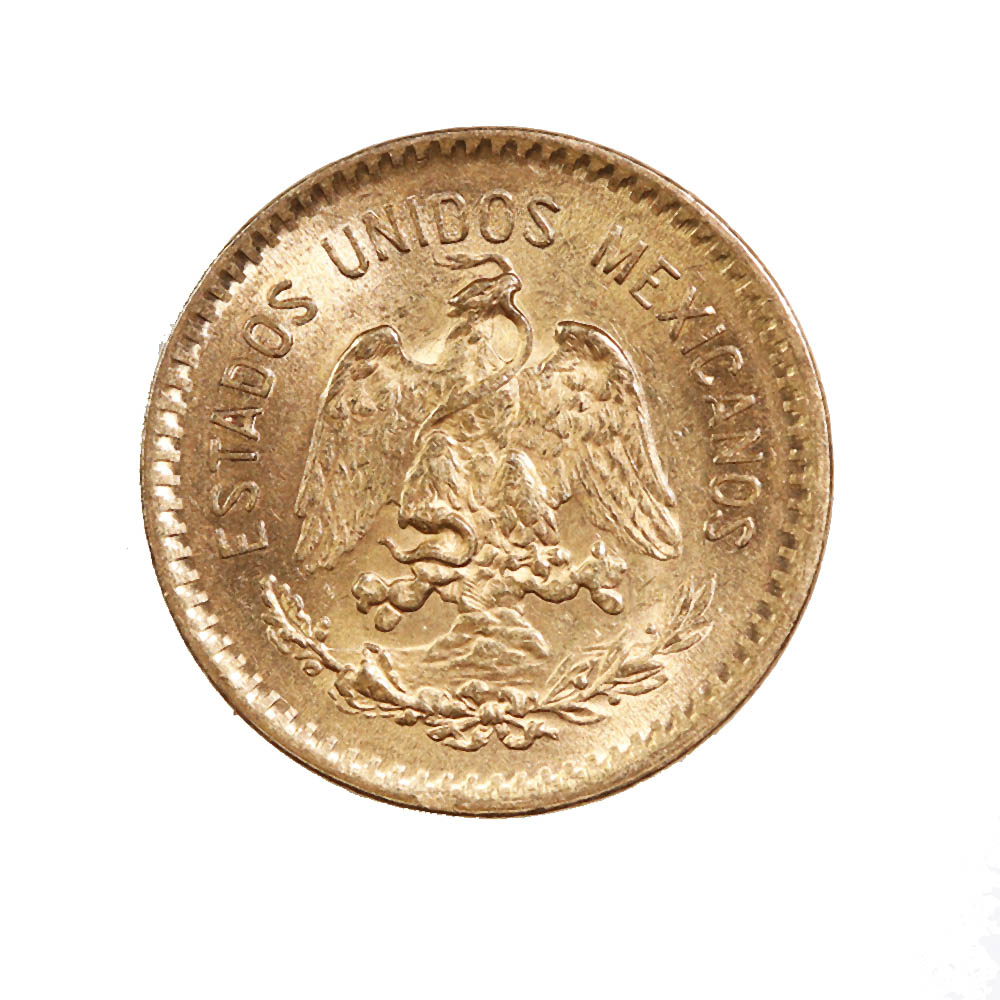
The obverse design of the 1906 Mexico 10 Pesos coin proudly features the classic Mexican national emblem: the eagle, perched on a prickly pear cactus, clutching a serpent in its beak and talon. This ancient Aztec symbol, rooted in the founding legend of Tenochtitlán (modern-day Mexico City), represents the triumph of good over evil and the enduring spirit of the Mexican people. The engraving captures the eagle’s feathers, wings, and muscular form in exquisite detail, while the cactus and serpent are rendered with lifelike precision. Surrounding the image are the words “ESTADOS UNIDOS MEXICANOS,” meaning “United Mexican States,” forming a complete circular legend along the rim. The outer beaded border frames the design harmoniously, emphasizing the strength and beauty of Mexico’s national identity. The balance between natural realism and symbolic depth makes this one of the most admired national emblems in coinage worldwide.
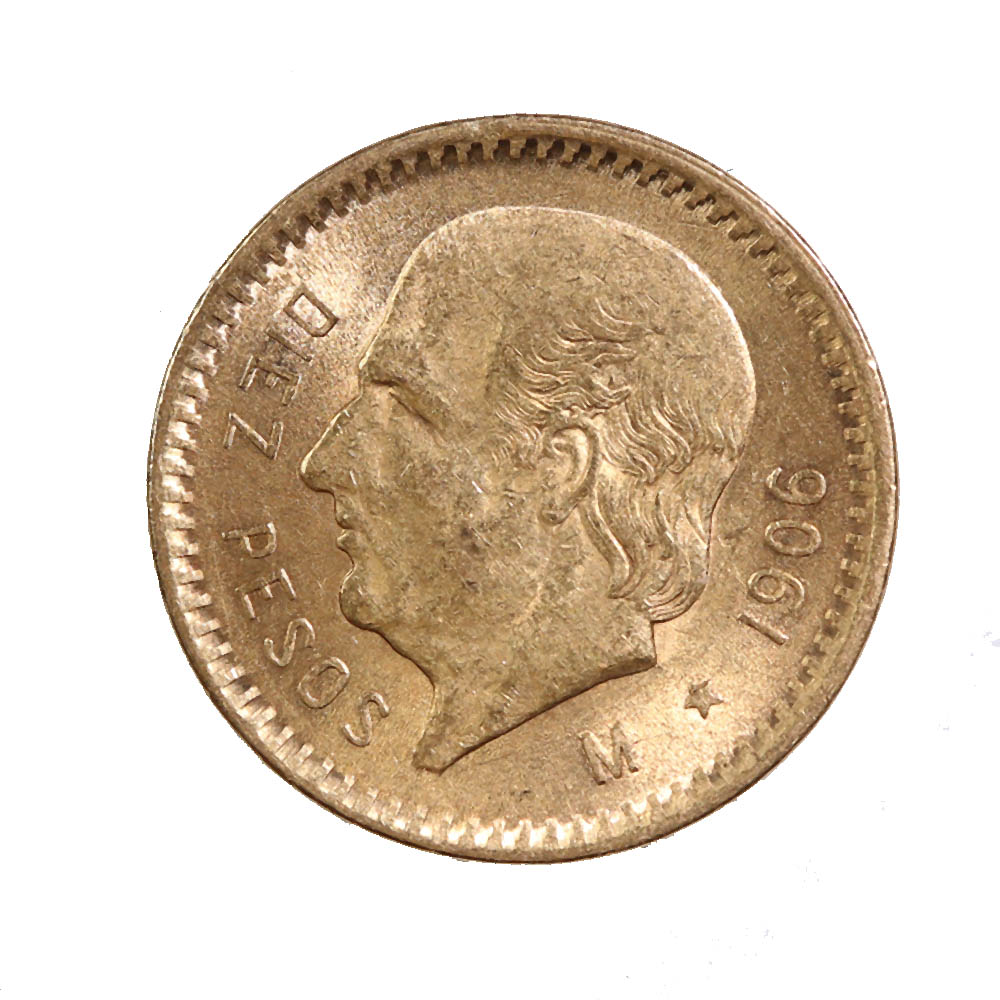
The reverse design is equally distinguished, featuring a finely detailed portrait of Miguel Hidalgo y Costilla, the revered priest and revolutionary hero who ignited the struggle for Mexican independence in 1810. Hidalgo’s right-facing bust captures both his intellectual strength and his revolutionary fervor, with sharply defined facial features, high forehead, and formal dress typical of the neoclassical style prevalent in early modern Latin American coinage. Around the periphery appears the legend “DIEZ PESOS” (Ten Pesos) above, while below the bust are the date “1906” and the gold purity inscription “LEY 0.900.” Beneath these elements sits the traditional mintmark “Mo,” denoting the *Casa de Moneda de México.* The design embodies elegance and gravitas, celebrating both the intellectual leadership and moral courage of Hidalgo, whose call to independence remains one of the most defining moments in Mexican history.
The Mexico 10 Pesos Gold series was first introduced in 1905, as part of a monetary reform that aligned Mexico’s gold standard with international norms. These coins were struck in denominations of 2½, 5, 10, and 20 Pesos, and they maintained consistency in design and fineness across denominations. The 10 Pesos denomination provided a balance between practicality and prestige—it was large enough for trade and savings but not as cumbersome or high-valued as the 20 Pesos piece. The year 1906 represents one of the earliest years of the series and coincides with a period of prosperity and modernization in Mexico, when infrastructure, railways, and foreign investment were transforming the nation’s economy.
The coin’s technical specifications make it both a reliable investment in gold and a historical artifact of considerable artistic merit. It weighs 8.33 grams and is composed of 90% gold and 10% copper, giving it durability and a distinctive reddish tone. The coin’s diameter measures approximately 22.5 millimeters, and the edge features an ornamental inscription rather than simple reeding—reading “INDEPENDENCIA Y LIBERTAD” (“Independence and Liberty”) in raised letters. This inscription encapsulates the political and cultural ideals born from Hidalgo’s revolution, reminding each holder of Mexico’s ongoing struggle and pride in sovereignty. The phrase and the precision with which it is engraved stand among the finest examples of patriotic symbolism integrated into numismatic design.
The mintage for the 1906 10 Pesos issue was modest compared to later dates, as Mexico’s gold coinage was primarily intended for circulation among wealthier citizens, merchants, and banks. Gold coins served both as a store of value and a symbol of national prestige. Many were later melted during periods of economic turmoil, particularly in the early twentieth century and again during global financial crises, which has reduced the number of surviving specimens in collectible grades. The limited availability of well-preserved examples enhances the desirability of the 1906 issue among collectors.
In About Uncirculated (AU) condition, the 1906 10 Pesos gold coin retains much of its original luster, with light wear visible only on the highest relief points—typically on Hidalgo’s hair, cheek, and collar, or the eagle’s breast feathers on the obverse. The surfaces may display faint contact marks from handling or storage, but overall eye appeal remains strong. The fields retain reflective brilliance, especially around protected areas, while the devices are sharp and well-defined. The coin’s natural reddish-golden tone, a result of the copper alloy, adds warmth and character, and many AU examples exhibit a delicate satiny sheen that enhances the artistry of the engraving. The strike quality from the Mexico City Mint was consistently high during this period, ensuring that even circulated specimens maintain impressive detail.
Historically, the 10 Pesos coin serves as both an economic and symbolic artifact. During the Porfirio Díaz presidency (1876–1911), Mexico experienced significant industrial and infrastructural development, as well as closer integration with global trade. The adoption of the gold standard reflected the country’s aspirations toward modernization and international credibility. The gold coins minted during this era—including the 1906 10 Pesos—became emblems of Mexico’s prosperity and ambition. Yet beneath this veneer of progress, social inequality and unrest were brewing, soon leading to the Mexican Revolution of 1910. In this sense, the coin also stands at the threshold between two epochs: one of order and economic expansion, and another of revolution and reform.
The artistry of the 1906 10 Pesos coin also reflects the broader trends in world numismatics of the early twentieth century. Like many contemporary European issues, it combines neoclassical portraiture with national symbolism. The engraving precision and relief depth achieved by the *Casa de Moneda de México* rivaled that of leading European mints, attesting to the mint’s centuries-long tradition of excellence. Each element—the fierce eagle, the dignified bust of Hidalgo, and the inscribed edge—was rendered with the care and balance that characterized Mexico’s golden age of coin design.
From a collector’s perspective, the Mexico 10 Pesos Gold 1906 coin occupies a special place in Latin American numismatics. It represents not only a cornerstone of Mexico’s gold standard system but also a connection to the nation’s identity and pride. Its moderate gold content makes it accessible to investors, while its artistry and limited mintage make it desirable to numismatists. Complete sets of early 1905–1910 10 Pesos coins, especially those retaining original surfaces, are increasingly scarce and command strong premiums in the marketplace.
Today, more than a century after its minting, the 1906 Mexico 10 Pesos Gold coin endures as a brilliant reflection of a nation in transformation—honoring its past while looking confidently toward the future. Its rich golden hue, historical resonance, and nearly unbroken luster in AU condition combine to make it both a visual delight and a tangible link to Mexico’s economic and cultural ascent in the early modern era. Whether admired for its aesthetic beauty, its intrinsic gold value, or its symbolic power, this coin remains one of the most elegant expressions of Mexican sovereignty and heritage ever struck in gold.


