
- Back to:
- Colonial Coins


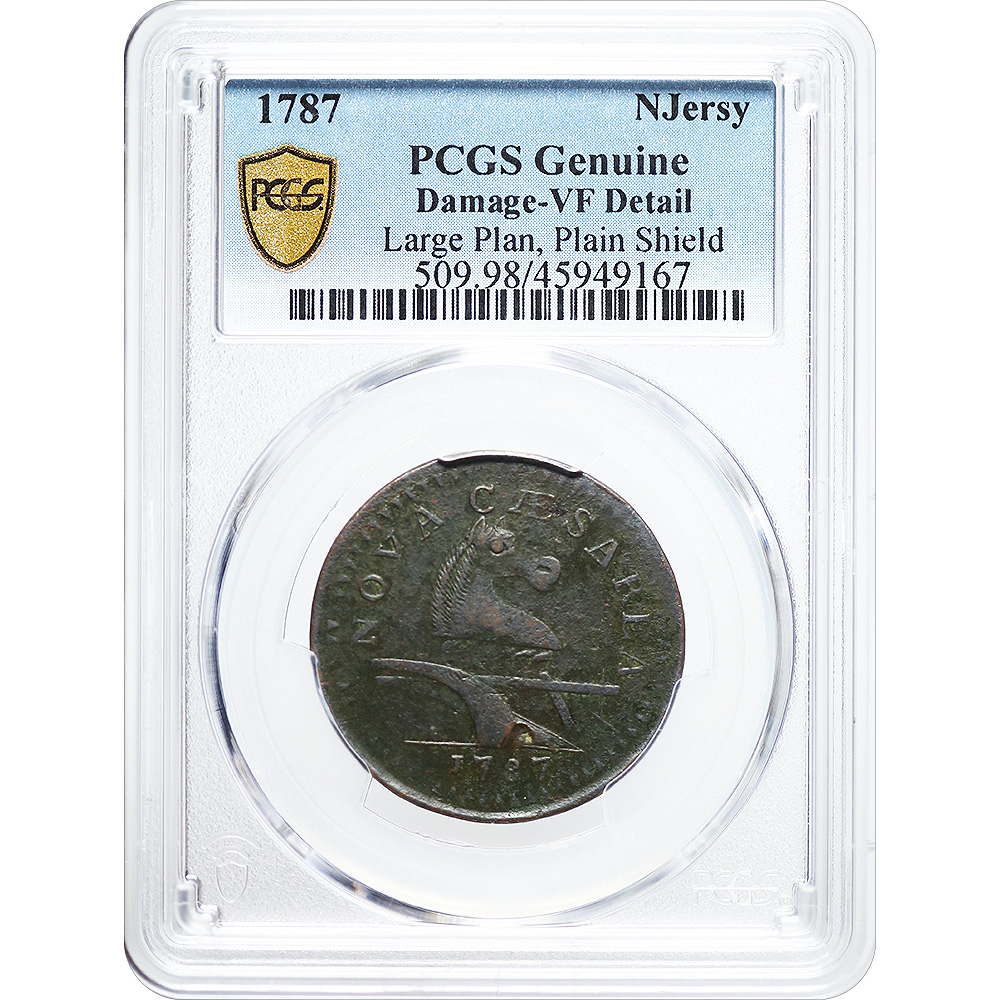
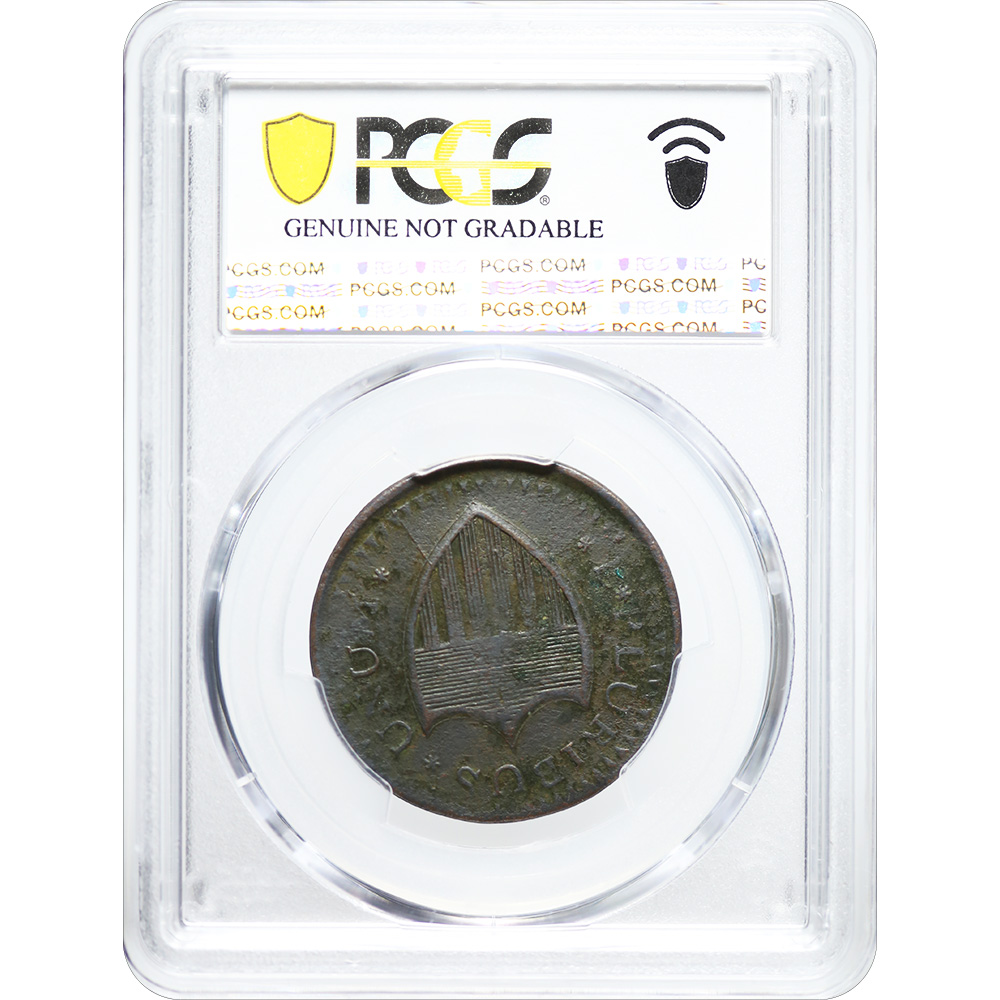
Colonial New Jersey Penny 1787 W-5380 VF Details PCGS
| Qty | Wire/Check | Bitcoin | CC/Paypal |
| Any | $595.00 | $600.95 | $618.80 |
The Colonial New Jersey Penny 1787 W-5380, certified by PCGS with VF Details, is a remarkable survivor from the earliest days of American coinage, struck during the final years before the ratification of the U.S. Constitution. This copper coin, often referred to as the “New Jersey Copper,” represents one of the most iconic and widely circulated colonial issues authorized by an individual state prior to the establishment of the federal mint. Struck under the authority of the State of New Jersey between 1786 and 1788, these coins were intended to provide a stable, trustworthy medium of exchange in a period when foreign and local coinage circulated side by side. The 1787 W-5380 variety is part of a vast and complex series that showcases the diversity of dies and workshops active in early American coining. Each example tells a story of political independence, economic necessity, and the birth of American numismatic identity. This particular specimen, graded Very Fine (VF) Details by PCGS, retains clear design definition, strong historical character, and an authentic colonial patina that connects it directly to the economic life of revolutionary America.
The obverse of the 1787 New Jersey Penny displays the state’s famous “Horse’s Head and Plow” motif, one of the most recognizable symbols in early American coinage. The design features a horse’s head facing right, above a detailed plow resting on the ground. Above the horse’s head, in graceful serifed letters, is the legend “NOVA CAESAREA,” the Latinized form of “New Jersey.” The imagery reflects both the agricultural heritage and industrious spirit of the state, symbolizing prosperity derived from honest labor. The horse, a traditional emblem of strength and independence, also evokes the colonial state’s cavalry traditions from the Revolutionary War. On this VF Details specimen, much of the obverse design remains visible—the horse’s neck and plow are distinct, while the surrounding legend is mostly legible despite light circulation wear. The surfaces show moderate smoothing typical of early copper, but the piece retains its strong devices and visual appeal, displaying the charm that defines genuine colonial copper coinage.
The reverse of the coin carries another design rich in symbolism and civic pride. At its center is a shield bearing thirteen vertical and horizontal stripes, representing the unity of the thirteen original colonies. Across the shield, the legend “E PLURIBUS UNUM” (“Out of Many, One”) appears on a ribbon—one of the earliest uses of this motto on American coinage, long before it was formally adopted for U.S. federal coins. The shield itself is a precursor to the national arms, reinforcing the coin’s role in forging early American identity. The outer legend “PLURIBUS UNUM” forms a perfect symbolic pairing with the obverse’s state-centered design, expressing the philosophical transition from colony to union. The border typically features a beaded circle, though on circulated examples like this, portions may appear worn or faint. On this specimen, the major elements of the reverse shield are still bold and defined, testifying to the coin’s robust strike and careful preservation despite centuries of age.
The 1787 W-5380 variety is identified by distinct die characteristics catalogued by numismatist Michael Hodder and other specialists. The “W” number corresponds to the indexing system established in Edward Maris’s landmark 1881 reference *A Historical Sketch of the Coins of New Jersey*, which catalogued the many obverse and reverse die pairings. The W-5380 variety typically features a well-proportioned horse head with a clearly outlined mane, paired with a reverse shield of uniform thickness and sharply cut horizontal lines. These distinguishing traits suggest production by a skilled die sinker working under the authority of a private contractor authorized by the New Jersey legislature. Like many other varieties in the series, the W-5380 issue was likely struck at Rahway or Elizabethtown using crude hand-powered screw presses, resulting in irregular planchets, off-center strikes, and die cracks—characteristics beloved by collectors of colonial Americana. Each surviving piece is slightly unique, making variety attribution both a science and an art within the field of early American numismatics.
Authorized by the New Jersey legislature in 1786, the state copper coinage was intended to alleviate chronic shortages of small change and to standardize commerce in a region still reeling from the disruptions of war. Contracts were issued to private coining firms to strike millions of coppers, with specifications calling for a weight of approximately 150 grains (about 9.7 grams) and a diameter of roughly 28 millimeters. These coins were struck in pure or nearly pure copper, their reddish-brown hue darkening over centuries to the chocolate tones collectors prize today. The designs were deliberately symbolic, chosen to reflect both New Jersey’s identity and its allegiance to the ideals of the emerging republic. The combination of Latin inscriptions, heraldic imagery, and agricultural motifs blended European artistic conventions with distinctly American themes, setting a precedent for future U.S. coinage that balanced unity, labor, and liberty. The New Jersey Coppers, alongside the Vermont, Connecticut, and Massachusetts state issues, thus form a foundational chapter in the history of U.S. money.
The mintage of New Jersey Coppers, while officially recorded at over three million pieces between 1786 and 1788, remains uncertain due to incomplete documentation and the decentralized nature of production. The W-5380 variety is one of the scarcer die pairings, distinguished by specific stylistic elements and subtle die wear visible on the horse’s mane and plow lines. Surviving specimens number in the low hundreds, though only a fraction are in problem-free, high-grade condition. Because many were struck on lightweight or clipped planchets, pieces often exhibit planchet flaws, minor porosity, or surface smoothing from long circulation. This PCGS VF Details specimen retains much of its design detail and overall eye appeal, despite light surface restoration, making it an attractive and historically significant representative of the type. Collectors value such pieces not only for their rarity but also for their individuality—each New Jersey Copper carries distinctive die cracks, rim irregularities, and striking idiosyncrasies that make every coin a tangible artifact of early American enterprise.
In terms of physical condition, this coin’s VF Details designation indicates that its main design features remain well-defined, with moderate wear on high points and clear legends on both sides. The horse’s head and plow are distinct, the shield’s vertical lines remain visible, and the legends “NOVA CAESAREA” and “E PLURIBUS UNUM” are legible. The coin exhibits a uniform medium-brown patina with lighter highlights on the devices, producing an attractive contrast under natural light. The “Details” qualifier from PCGS suggests minor surface smoothing or cleaning in the past—common among colonial-era copper coins—but the piece retains full authenticity, solid integrity, and honest eye appeal. The edges are even, the planchet stable, and the overall aesthetic that of a well-preserved working coin that circulated during the nation’s founding years. Collectors often prefer such examples for their combination of sharp detail and genuine historical texture.
The historical resonance of the 1787 New Jersey Penny extends beyond numismatics into the broader narrative of America’s political and economic birth. These coins circulated alongside foreign coppers, Spanish reales, and early tokens in taverns, markets, and trade houses across the mid-Atlantic. Each piece was a small but powerful assertion of sovereignty, declaring that the states could—and did—exercise authority over their own economies. The inscriptions “Nova Caesarea” and “E Pluribus Unum” reflected both state pride and an emergent federal ideal, foreshadowing the unification that would soon follow under the new Constitution. In this sense, the New Jersey Copper occupies the symbolic middle ground between colonial dependence and national independence. Every surviving specimen is thus a relic of that transformation—an artifact from the moment when America’s identity was being minted, quite literally, into existence.
From a numismatic perspective, the Colonial New Jersey Penny 1787 W-5380 VF Details PCGS is an essential piece for collectors of early American coinage, colonial currency, or state-issued money. Its combination of beauty, rarity, and historical meaning captures the essence of pre-federal numismatics. The PCGS certification guarantees authenticity and provides scholarly attribution within the Maris-W numbering system, ensuring confidence for collectors and historians alike. While the “Details” grade acknowledges past handling, the coin’s overall integrity and visual appeal remain strong, preserving its role as a tangible artifact of revolutionary America. As one of the foundational issues of American coinage, the New Jersey Copper continues to inspire admiration not only for its craftsmanship but also for what it represents—the determination of a young nation to define its own identity, economy, and ideals through metal, art, and independence.


