
- home
- Buy Gold
- World Gold Coins
- Central and South American Gold Coins
- Colombia 300 Pesos 1968 PF International Eucharistic Congress


Colombia 300 Pesos 1968 PF International Eucharistic Congress
| Qty | Wire/Check | Bitcoin | CC/Paypal |
| Any | $1,784.14 | $1,801.98 | $1,855.51 |
The Colombia 300 Pesos 1968 Proof International Eucharistic Congress gold coin is one of the most elegant and historically significant numismatic issues of mid-twentieth-century Latin America. Struck in .900 fine gold by the Casa de Moneda de Colombia, the nation’s official mint, this coin was produced to commemorate the 39th International Eucharistic Congress held in Bogotá in 1968 — an event of great religious, cultural, and diplomatic importance. The congress marked the first time the global Catholic gathering was hosted in South America, symbolizing both Colombia’s deep spiritual heritage and its growing prominence within the modern world. With its limited mintage, exquisite proof finish, and deeply meaningful theme, the 1968 300 Pesos stands as one of Colombia’s most collectible modern gold issues.
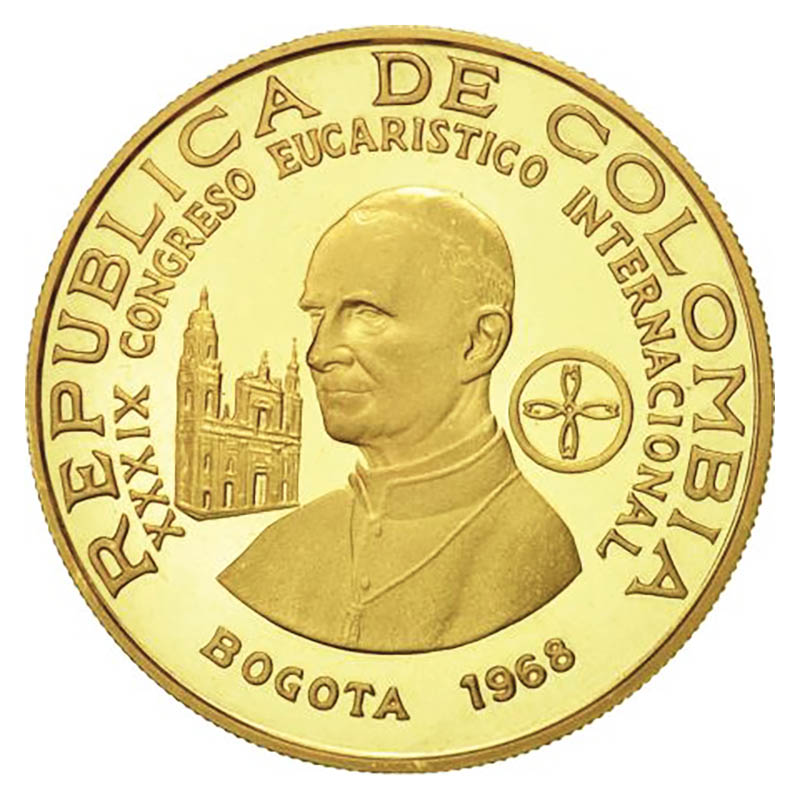
The obverse design of the coin features a superbly rendered portrait of Pope Paul VI, the pontiff who presided over the 1968 congress and whose papacy spanned from 1963 to 1978. He is depicted facing right, wearing the traditional papal mozzetta and zucchetto. The engraving is crisp and lifelike, capturing the gentle dignity and serene strength of Paul VI’s features. Around the portrait runs the Latin legend “PAULUS VI PONTIFEX MAXIMUS A.D. MCMLXVIII,” which translates to “Paul VI, Supreme Pontiff, A.D. 1968.” The mirrorlike proof fields surrounding the frosted portrait create an elegant contrast that emphasizes the spiritual gravitas of the subject. The obverse exemplifies the fine craftsmanship of the Colombian mint during a period when national coinage combined religious symbolism with artistic refinement.
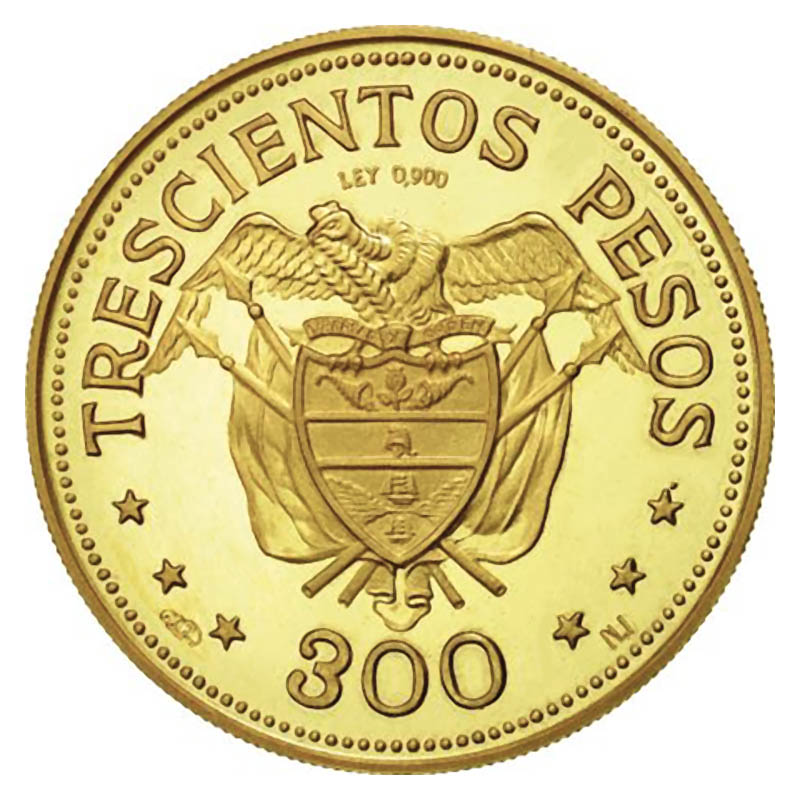
The reverse design commemorates the 39th International Eucharistic Congress itself. Dominating the center is a radiant chalice, from which rays of divine light emanate outward, symbolizing the Eucharist — the sacrament central to Catholic faith. Above the chalice hovers a small cross and the Sacred Host bearing the monogram “IHS,” an ancient Christogram signifying the name of Jesus. Around the central motif appears the inscription “XXXIX CONGRESO EUCARÍSTICO INTERNACIONAL BOGOTÁ 1968.” Beneath the design, along the lower border, is the denomination “300 PESOS,” elegantly curved to balance the composition. The detailed engraving, combined with the mirrorproof background, gives the impression of heavenly radiance — a visual metaphor for divine grace and the spiritual unity that the congress sought to foster across nations.
The coin’s specifications reflect both its artistic and monetary value. It was struck in .900 fine gold (90% gold and 10% copper alloy) with a total weight of 22.24 grams, yielding 20.02 grams (approximately 0.643 troy ounce) of pure gold content. Its diameter measures about 34 millimeters, and it features a reeded edge. The proof finish, achieved through multiple strikes of polished dies against specially prepared planchets, ensures mirrored fields of remarkable depth and sharp relief in the design elements. Each coin was carefully handled to preserve its flawless surface and issued in a protective capsule or plush presentation case, often accompanied by a certificate of authenticity from the Casa de Moneda or the Colombian government.
The mintage of the 1968 300 Pesos gold coin was notably limited, intended primarily for presentation and collectors rather than for circulation. Contemporary records suggest that only a few thousand pieces were struck in proof quality, making this issue scarce today, particularly in pristine condition. Many examples were distributed as diplomatic gifts or sold through ecclesiastical and numismatic channels to commemorate the congress. Because of its low mintage and gold content, the coin enjoys enduring demand among both collectors of Latin American proofs and those interested in Vatican-related or religious commemoratives.
The 39th International Eucharistic Congress itself was a milestone event that brought global attention to Colombia. Held in Bogotá from August 22 to August 25, 1968, it drew hundreds of thousands of pilgrims and clergy from around the world, including bishops, cardinals, and papal representatives. It was presided over by Pope Paul VI in person — the first pontiff ever to visit the Americas. His arrival symbolized the Catholic Church’s outreach to Latin America during a time of social transformation and modernization following the Second Vatican Council. The congress emphasized themes of peace, renewal, and unity in the faith, values that resonated strongly in a region striving for social harmony and development. The coin’s imagery of the radiant chalice and host beautifully encapsulates these ideals.
The artistry of the 1968 300 Pesos proof coin reflects the maturity and precision of the Casa de Moneda de Colombia’s mid-century minting capabilities. Founded in 1621, the mint is one of the oldest operating in the Americas, and by the late 1960s it had adopted modern minting technologies that allowed for flawless proof finishes rivaling those of the world’s finest mints. The engraving on both sides of the coin demonstrates expert modeling, crisp relief, and symmetrical composition. The blending of national and religious iconography — a hallmark of Colombian commemoratives — conveys both devotion and craftsmanship. The choice of gold as the medium further enhances its symbolic power, linking divine illumination to material excellence.
In terms of condition, a Proof (PF) example of the 1968 Colombia 300 Pesos typically displays immaculate surfaces with no signs of handling or wear. The fields are deeply mirrored, while the raised designs exhibit a subtle frosted texture. Under magnification, the fine details of Pope Paul VI’s features, the chalice’s engraving, and the lettering remain sharp and clean. Over time, some coins may acquire a faint honey or reddish tone, caused by the slight copper content in the alloy — a natural patina that often enhances the coin’s visual warmth. Collectors value examples that remain free of hairlines or milk spots, as such imperfections can reduce the brilliance of the proof finish. Properly stored specimens in their original capsules retain their original luster for decades.
The 300 Pesos denomination was significant in Colombia’s monetary system at the time. Introduced specifically for commemorative gold issues, it reflected the high prestige associated with events of national and international importance. Earlier Colombian gold coins, such as the 100 Pesos and 200 Pesos proofs of the 1960s, had set the precedent for limited-edition ceremonial coinage. The 1968 issue continued that tradition while elevating it with religious gravitas, linking the country’s national minting heritage to a worldwide spiritual celebration.
Collecting interest in Colombian gold proof coins of the 1960s and 1970s has increased steadily in recent decades, driven by their low mintages, historical depth, and superb workmanship. The 1968 300 Pesos issue stands out as particularly meaningful due to its association with the Vatican and Pope Paul VI’s visit. For numismatists specializing in ecclesiastical or Latin American coinage, it occupies a prominent place in the narrative of post-war commemorative art. Its elegant simplicity, mirror-polished surfaces, and limited distribution lend it an aura of refinement rarely matched in contemporary world coins.
Today, the Colombia 300 Pesos 1968 Proof International Eucharistic Congress gold coin endures as both a symbol of faith and a testament to numismatic excellence. It unites sacred meaning with technical artistry, capturing the spirit of a pivotal moment when Colombia stood on the world stage as the host of a global religious gathering. With its blend of devotional imagery, precious metal beauty, and historical resonance, it continues to inspire admiration among collectors worldwide. In proof condition, its enduring brilliance and deeply spiritual design remind us that coinage can serve not only as a medium of exchange but also as a lasting expression of culture, belief, and craftsmanship.
KM#233,


