
- home
- Tokens & Medals
- U.S. Medals
- Coca-Cola Brass Medal 45mm 1915 Annual Convention--$50 Pan-Pacific Design
- Back to:
- U.S. Medals


Coca-Cola Brass Medal 45mm 1915 Annual Convention--$50 Pan-Pacific Design
| Qty | Wire/Check | Bitcoin | CC/Paypal |
| Any | $195.00 | $196.95 | $202.80 |
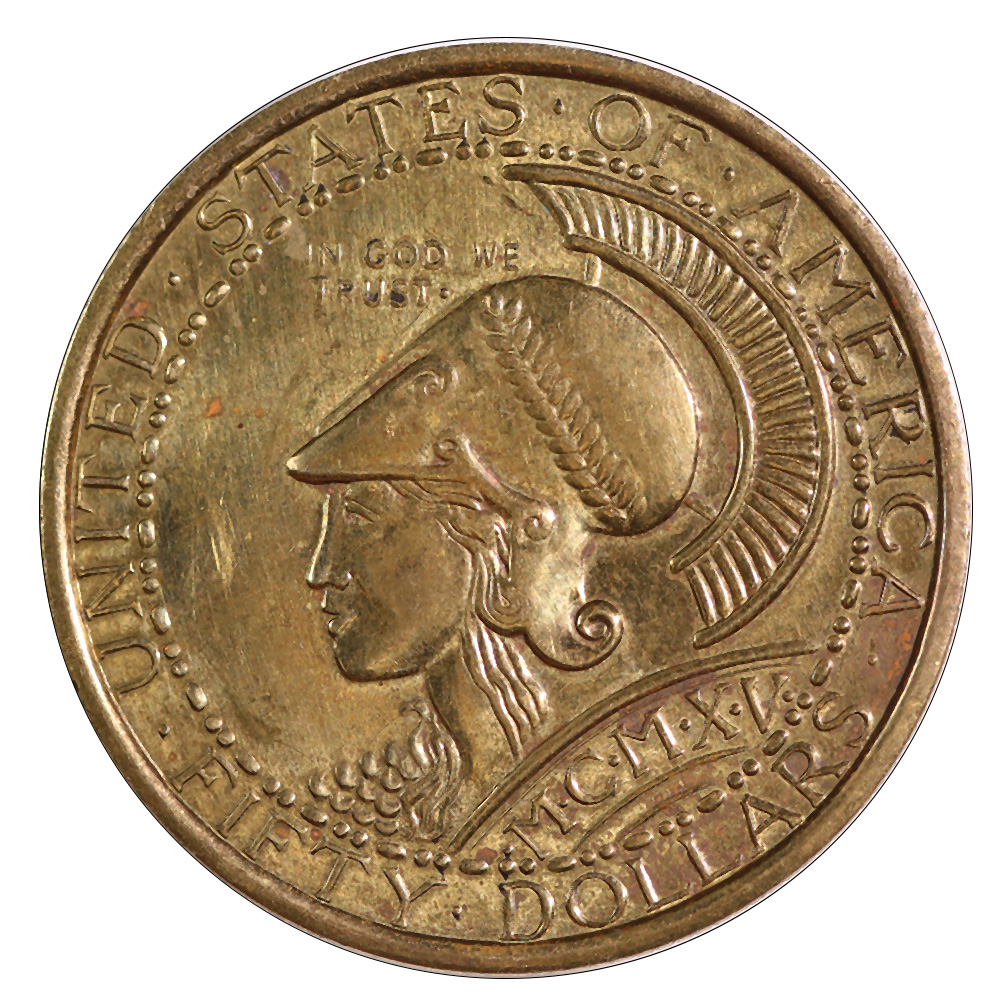
The Coca-Cola Brass Medal 45mm 1915 Annual Convention—$50 Pan-Pacific Design is a fascinating and historically significant piece of early twentieth-century American advertising and exposition medallic art. Struck in 1915, this medal was issued for Coca-Cola’s annual bottlers’ convention, held in the same year as the famed Panama-Pacific International Exposition in San Francisco. Its design borrows from the celebrated 1915 U.S. $50 gold commemorative pieces—one of the most iconic coin designs ever produced by the United States Mint—making this medal a rare intersection of numismatic beauty, corporate history, and American commercial culture. Crafted in brass and measuring an impressive 45 millimeters in diameter, the Coca-Cola convention medal reflects the grandeur of the era’s industrial exhibitions and the company’s growing stature as a national brand.
The year 1915 was pivotal both for Coca-Cola and for American design. The Panama-Pacific Exposition in San Francisco celebrated the completion of the Panama Canal and symbolized the United States’ emergence as a modern global power. The exposition’s official coinage, particularly the round and octagonal $50 gold pieces designed by Robert I. Aitken, were admired for their allegorical depictions of Columbia, the personification of America, and the symbolism of peace, progress, and discovery. Coca-Cola, which had been founded just three decades earlier, was by 1915 expanding rapidly through its network of independent bottlers. The company’s annual conventions were grand affairs, promoting innovation, cooperation, and the spirit of enterprise—qualities that paralleled the themes celebrated at the Pan-Pacific fair. The decision to model the convention medal after the $50 gold coin design was both a nod to contemporary artistic excellence and a declaration of Coca-Cola’s confidence as an emerging national institution.
The obverse of the 1915 Coca-Cola brass medal features a detailed adaptation of the Panama-Pacific $50 coin design. At its center is the standing figure of Columbia, robed and holding a caduceus in her right hand and a shield in her left, symbolizing peace and protection. Behind her rises the radiant sun over calm seas, while two dolphins frame the lower portion of the design, representing the meeting of the Atlantic and Pacific Oceans through the newly completed canal. Around the upper periphery, the inscription “COCA-COLA ANNUAL CONVENTION 1915” replaces the original coin legend, while decorative beading or a raised border encloses the composition. The meticulous engraving preserves the high artistry of the original government design while integrating the corporate identity in a tasteful and celebratory manner.
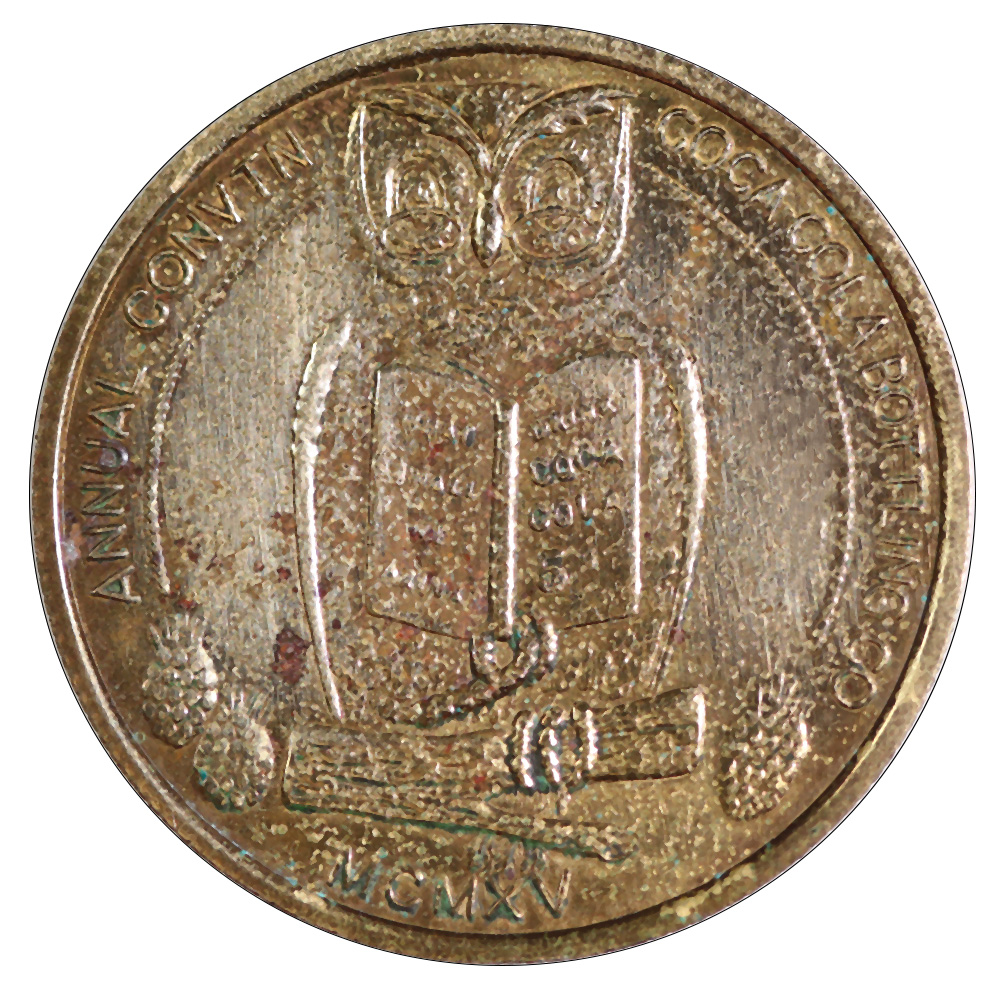
The reverse of the medal continues the Pan-Pacific theme, echoing the $50 coin’s reverse motif. It displays the majestic figure of an owl perched on a branch, symbolizing wisdom, commerce, and foresight—traits that resonated deeply with Coca-Cola’s business philosophy at the time. The inscription “THE COCA-COLA COMPANY / ANNUAL CONVENTION” is prominently displayed, often arranged in two or three lines across the upper field, while decorative flourishes or wreaths fill the lower section. Some examples may include the host city or additional text referencing the bottlers’ association, depending on the specific issue or engraving variation. The artistry of the piece demonstrates that it was not a crude promotional token but rather a true commemorative medal produced with professional craftsmanship.
The medal was struck in brass, a durable and lustrous alloy that allowed for fine detail while keeping production costs manageable for wide distribution among convention attendees. The 45-millimeter diameter provided ample surface area for intricate engraving and a substantial feel in hand, similar in size to contemporary exposition medals. Many pieces exhibit an attractive golden-bronze tone, with slight variations depending on alloy composition and aging. The rims were finely raised to protect the design from wear, while the surfaces were given a polished or lightly matte finish to enhance contrast between the relief and fields. Examples that have been well preserved retain a rich, warm patina and subtle iridescence, attesting to the high quality of the striking.
The Coca-Cola Annual Convention medals of the early 1900s were produced in limited numbers and distributed exclusively to company executives, bottlers, and delegates attending the event. These gatherings played an essential role in shaping the corporate identity of Coca-Cola, fostering unity and enthusiasm among its growing network of partners. The 1915 issue, tied so closely to the themes of the Panama-Pacific Exposition, carries additional symbolic weight as it reflects both the optimism of the era and the company’s commitment to national and international expansion. Surviving examples of this brass Pan-Pacific design are scarce, as few were produced and many have been lost or melted over the past century.
The artistic lineage of the design makes this medal particularly desirable among collectors. The original $50 gold coin by Aitken was never widely distributed due to its high face value and limited mintage, making it one of the most famous rarities in U.S. coinage. Coca-Cola’s adoption of the design for its 1915 medal effectively transformed that symbol of American progress into a corporate emblem celebrating innovation and success. The company’s decision to align its imagery with the nation’s leading exposition demonstrates a sophisticated understanding of marketing and aesthetics. In this sense, the 1915 medal is an artifact not just of numismatic beauty but of early twentieth-century branding at its most visionary.
The condition of surviving medals varies, though many have endured remarkably well due to the durability of brass. Well-preserved examples display sharp relief on Columbia’s figure, clean lettering, and minimal surface wear. Natural toning often gives the medal a handsome antique finish, with shades of gold, amber, and olive accentuating the engraved details. Light edge rubbing or small contact marks are typical of medals distributed at conventions, but these do not detract from overall appeal. The 45-millimeter size makes the piece ideal for display, and many were originally housed in small paper envelopes or simple presentation boxes marked “The Coca-Cola Company.” Medals that retain such packaging are particularly rare and highly collectible.
The historical context of this piece enhances its desirability. In 1915, Coca-Cola also introduced one of its most enduring symbols—the contour glass bottle, patented that same year. Thus, the medal not only commemorates the annual convention but also coincides with a defining moment in the company’s visual identity. The year encapsulated Coca-Cola’s transformation from a successful American brand into a modern industrial icon with global aspirations. As such, this 1915 brass medal serves as a tangible representation of a turning point in both corporate and cultural history.
Today, the Coca-Cola Brass Medal 45mm 1915 Annual Convention—$50 Pan-Pacific Design stands as a rare and treasured artifact, valued by collectors of both numismatics and Americana. It represents the fusion of artistic inspiration from the U.S. Mint’s finest commemorative work with the entrepreneurial spirit of one of the world’s most recognizable brands. Its elegance, historical significance, and scarcity make it a centerpiece in collections of early Coca-Cola memorabilia or exposition-era medals. With its brilliant design and deep symbolic roots in the themes of progress, wisdom, and unity, this 1915 issue endures as one of the most remarkable corporate medals of its time—a gleaming tribute to the golden age of American enterprise and design.


