
- Back to:
- $20 Notes


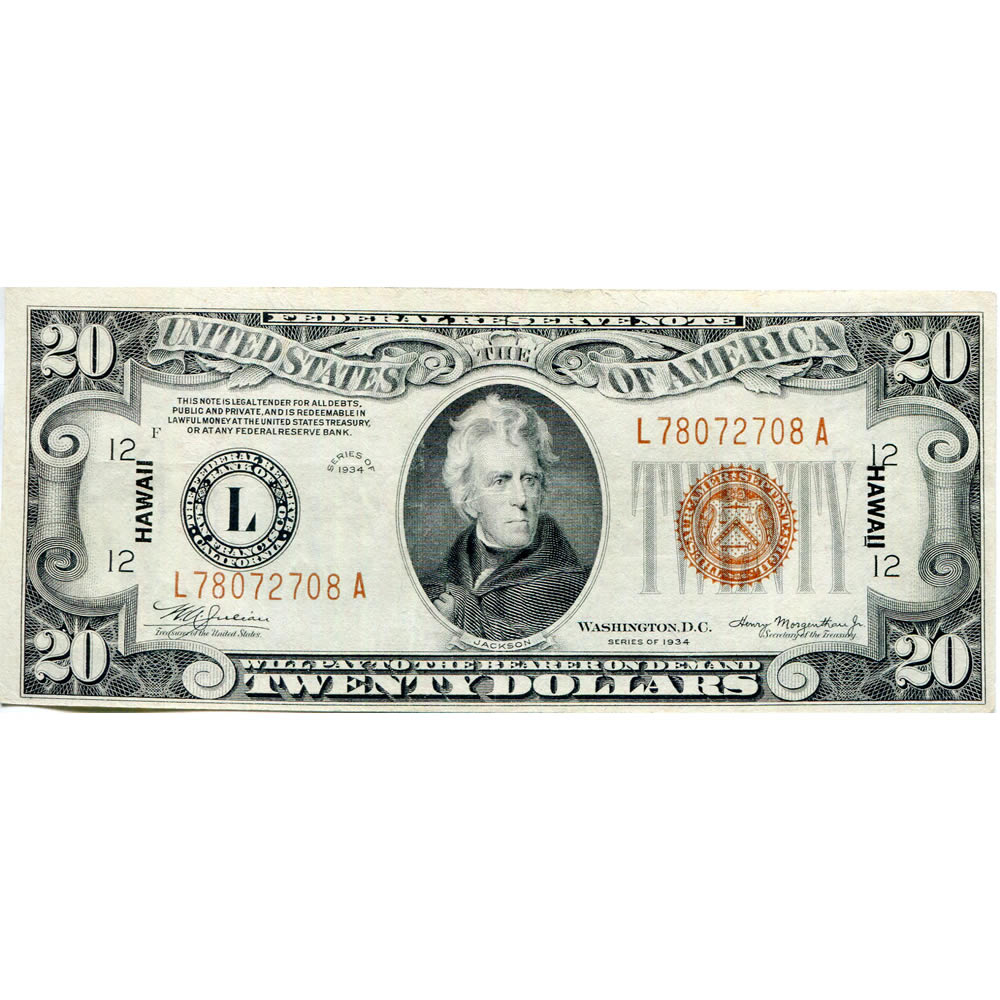
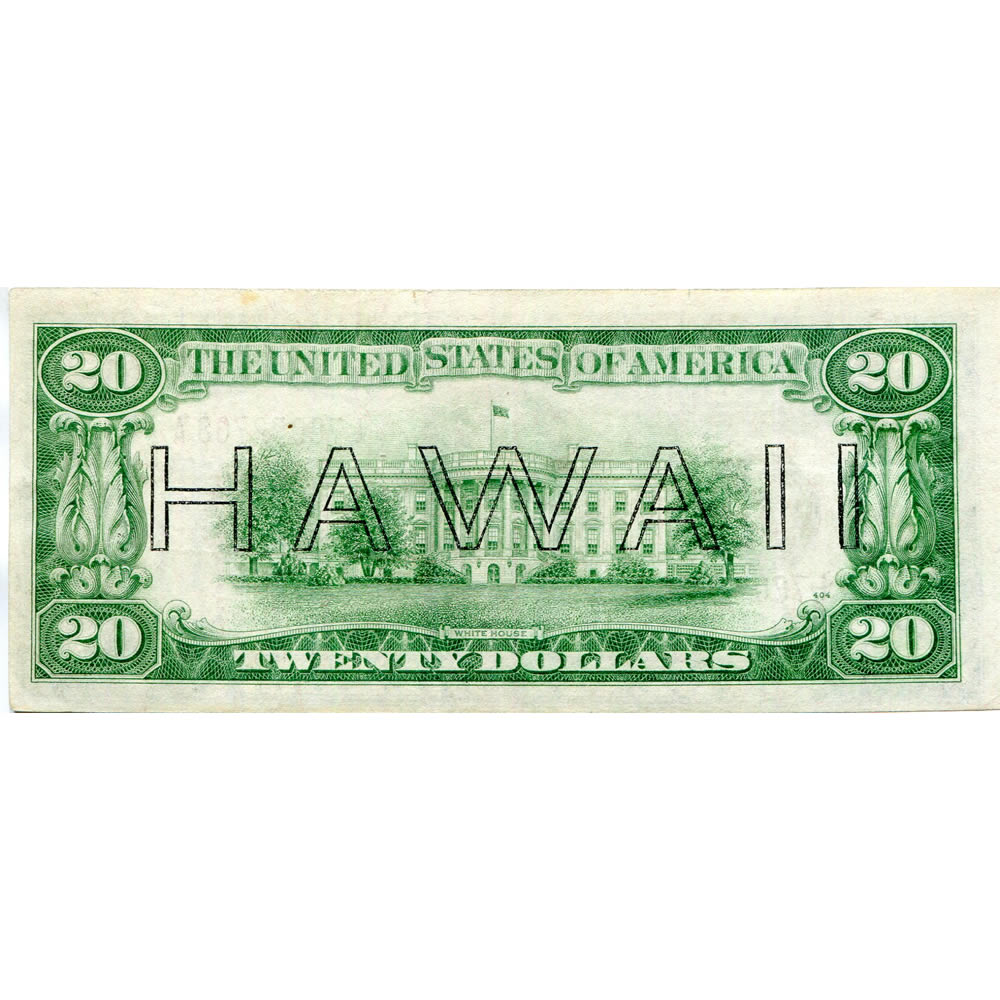
1934 Hawaii $20 Federal Reserve Note XF
| Qty | Wire/Check | Bitcoin | CC/Paypal |
| Any | $195.00 | $196.95 | $202.80 |
The 1934 Hawaii $20 Federal Reserve Note is a historically significant piece of United States paper currency, issued specifically for circulation in the Territory of Hawaii. Produced during the interwar period, these notes were created with overprints and unique designations to distinguish them from mainland notes and to allow them to be declared worthless if captured by enemy forces during World War II. The 1934 series represents one of the earliest Hawaiian overprint notes, reflecting both the economic conditions of the territory and the U.S. government’s foresight in protecting strategic assets. Its XF (Extremely Fine) condition, preserving crisp details with minor circulation wear, enhances its collectible value for both currency enthusiasts and historical collectors.
The obverse of the 1934 Hawaii $20 note features a finely detailed portrait of Andrew Jackson, the seventh President of the United States, centered within an ornate frame. Surrounding Jackson are intricate scrollwork, the denomination “TWENTY DOLLARS,” and the overprint “HAWAII” prominently displayed across the note. The serial number and Federal Reserve seal further confirm its authenticity. The overprint was specifically applied to all Hawaii notes to allow quick invalidation in the event of capture, a precautionary measure during a period of geopolitical uncertainty in the Pacific region. The portrait of Jackson is sharp and well-engraved, reflecting the high-quality design standards of the Bureau of Engraving and Printing in the 1930s.
The reverse features a finely engraved depiction of the U.S. Treasury Building, framed by ornate scrollwork and the denomination numerals “20.” The overprint “HAWAII” is repeated subtly within the design, reinforcing its territorial specificity. The reverse layout emphasizes both aesthetic appeal and clarity of denomination, making the note easily identifiable and usable for commerce while maintaining the detailed engraving and intricate borders typical of Federal Reserve Notes of the era.
The 1934 Hawaii $20 note was printed on high-quality cotton-linen paper with embedded security features designed to prevent counterfeiting. Its circulation in Hawaii was intended to support local commerce while providing a safeguard against the potential loss of large-value currency during wartime. The Extremely Fine (XF) grade indicates that the note has minor circulation handling, with slight folds and very light corner wear, yet the majority of design details, overprints, and intricate borders remain crisp and fully visible. XF notes are highly sought after because they preserve both aesthetic quality and historical integrity.
Historically, the Hawaiian overprint notes were a unique response to strategic concerns in the Pacific. In the event of Japanese invasion during World War II, all Hawaii notes could be declared void, preventing them from being used as currency by occupying forces. The 1934 $20 Hawaii note exemplifies this precaution and highlights the U.S. government’s foresight in territorial security, blending numismatic interest with military and historical significance. It circulated widely in Hawaii prior to and during the early years of World War II, serving both as legal tender and as a historical artifact.
Numismatically, the 1934 Hawaii $20 Federal Reserve Note XF is highly prized among collectors of U.S. paper money, territorial notes, and World War II-related currency. Reference works and Federal Reserve catalogs highlight its rarity, historical context, and collectible value. XF-grade notes offer a balance between condition and affordability, preserving crisp details and overprints while providing a tangible connection to Hawaii’s economic and strategic history. Collectors of Hawaii notes particularly value this issue for its combination of design, historical importance, and unique overprint security feature.
The note also demonstrates the technical and artistic capabilities of the Bureau of Engraving and Printing. The precise engraving of Andrew Jackson’s portrait, the Treasury Building, and intricate scrollwork shows high-quality craftsmanship. Even in XF condition, the note retains clarity of detail, allowing collectors to study both artistic elements and territorial overprint features. The Hawaii overprint adds a layer of historical and educational interest, illustrating how currency design was adapted for strategic purposes during the early 20th century.
In summary, the 1934 Hawaii $20 Federal Reserve Note XF is a historically and numismatically significant example of territorial U.S. paper money. Its obverse features Andrew Jackson, overprinted with “HAWAII” for strategic wartime purposes, while the reverse depicts the U.S. Treasury Building with detailed engraving and denomination markers. Its Extremely Fine grade preserves most design elements with minor circulation wear, making it both a collectible and a tangible connection to Hawaii’s economic and wartime history. The note represents an important intersection of U.S. numismatics, territorial administration, and military foresight.
Ultimately, the 1934 Hawaii $20 Federal Reserve Note XF offers collectors a unique blend of historical significance, intricate design, and preserved condition. Its territorial overprint, detailed engraving, and XF-grade preservation make it a prized addition to any collection of U.S. paper money, Hawaii-specific currency, or World War II-era numismatic artifacts, bridging historical study with collectible value.


