
- Back to:
- $5 Notes


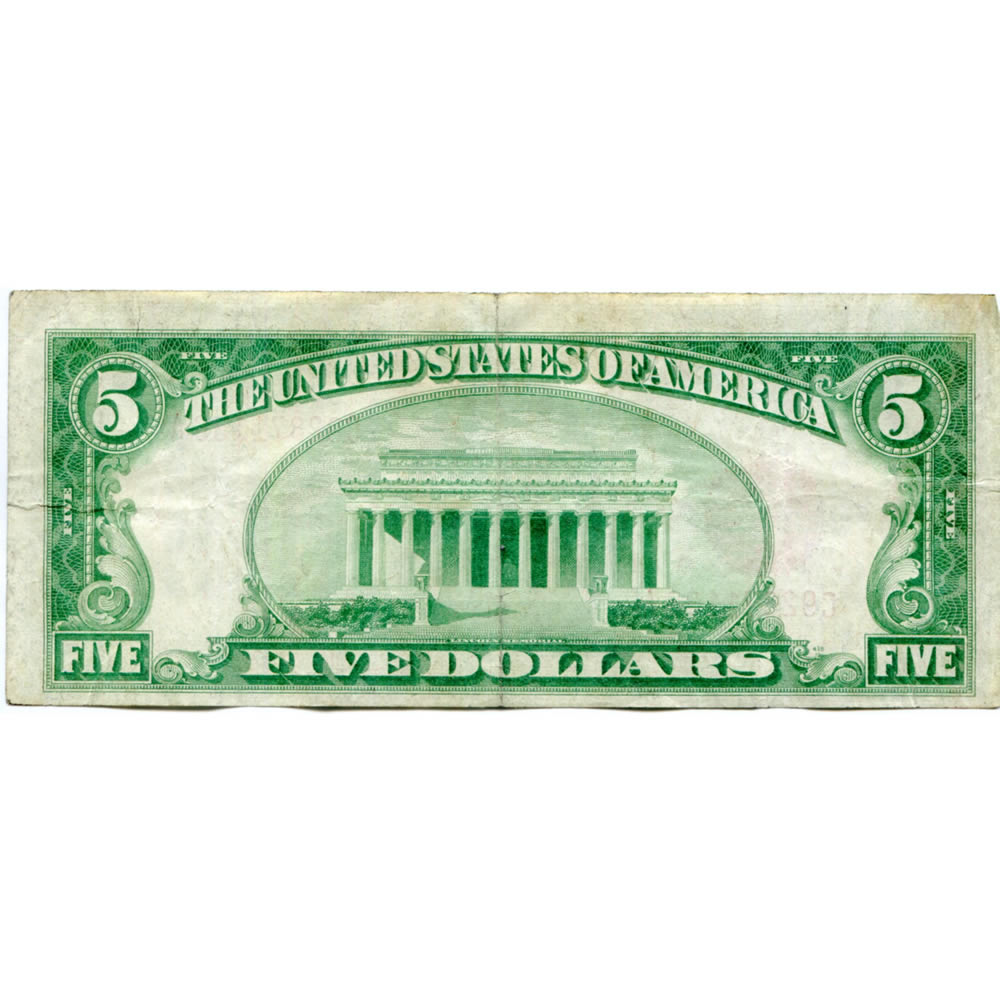
1928A $5 United States Note Red Seal VF
| Qty | Wire/Check | Bitcoin | CC/Paypal |
| Any | $22.95 | $23.18 | $23.87 |
The 1928A $5 United States Note with the distinctive red Treasury seal in Very Fine (VF) condition is an enduring relic of America’s early small-size paper currency era. As part of the first generation of reduced-format Legal Tender Notes, this issue embodies both artistic mastery and historical transformation in U.S. monetary design. Bearing the bold red seal and matching red serial numbers that distinguished United States Notes from their Federal Reserve counterparts, the 1928A series combined traditional engraving beauty with the modernized dimensions introduced in 1928. The note’s obverse features a powerful portrait of Abraham Lincoln, while the reverse displays the stately Lincoln Memorial—two enduring American symbols that together create one of the most elegant and unified designs in U.S. currency history. In Very Fine condition, this example exhibits moderate circulation with only light folds and wear, yet retains strong color, legibility, and crispness, making it a well-preserved specimen from an era of significant economic and political change.
The 1928A series of United States Notes followed the historic redesign that introduced the small-size format to American currency. Prior to this transition, U.S. paper money had been significantly larger, measuring approximately 7.375 by 3.125 inches—an inconvenient size for wallets, wallets, and cash registers. To reduce costs and improve practicality, the Treasury Department adopted the smaller 156 by 66 millimeter (6.14 by 2.61 inch) format still used today. These newly proportioned notes debuted in denominations ranging from $1 to $100, and each series introduced in 1928 featured distinctive color-coded seals to denote their type. The red-seal Legal Tender Notes—or “United States Notes”—represented direct obligations of the federal government under the authority of the 1878 Legal Tender Act, unlike the green-seal Federal Reserve Notes backed by the assets of the Reserve Banks. The 1928A $5 issue was signed by W.A. Julian as Treasurer of the United States and Ogden L. Mills as Secretary of the Treasury, identifying it as part of the second printing phase of small-size $5 United States Notes, following the initial 1928 issue signed by Woods and Mellon.
The obverse design of the 1928A $5 United States Note centers on a stately portrait of Abraham Lincoln, engraved in remarkable detail from the famous 1864 photograph taken by Anthony Berger. Lincoln’s calm yet resolute expression conveys dignity and compassion, qualities that resonate with the note’s symbolic significance. Surrounding the portrait is an ornate frame featuring intricate guilloche patterns and balanced scrollwork typical of early 20th-century engraving. Across the top appears the inscription “UNITED STATES NOTE,” denoting its Legal Tender status, while “THE UNITED STATES OF AMERICA” and “FIVE DOLLARS” are printed prominently above and below. The red Treasury seal is positioned to the right of Lincoln’s portrait, offset by two serial numbers in matching red ink—one to the left and one to the upper right. A large numeral “5” appears within a circular medallion to the left, providing visual symmetry. Below the portrait, the signatures of Julian and Mills appear in elegant script, authenticating the note’s official issue. The vivid contrast between the deep black engraving and the bright red overprint creates a striking and unmistakable visual identity that continues to captivate collectors nearly a century later.
The reverse design, executed entirely in green ink, presents a finely detailed engraving of the Lincoln Memorial in Washington, D.C. Completed in 1922 and quickly recognized as one of the most powerful architectural symbols of American unity, the memorial was an ideal choice for the reverse of the note. The Bureau of Engraving and Printing captured every element of the structure with meticulous precision—from its neoclassical columns and stairways to the seated statue of Lincoln faintly visible between them. Above the monument appears the inscription “THE UNITED STATES OF AMERICA,” while “FIVE DOLLARS” is printed boldly below. The denomination “5” also appears in each corner, surrounded by delicate scrollwork. The reverse layout demonstrates symmetry and restraint, hallmarks of the BEP’s engraving craftsmanship. The use of green ink—later to become the standard for all U.S. currency—symbolized stability and growth, while also serving as an anti-counterfeiting measure, as green pigments were difficult to reproduce accurately in the early 20th century.
The 1928A $5 United States Note was printed on high-quality paper composed of 75% cotton and 25% linen fibers, with small red and blue threads embedded throughout as a security feature. The Bureau of Engraving and Printing employed the intaglio printing method, in which steel plates are deeply engraved with the design and then pressed into the paper under immense pressure, leaving raised ink lines that can be felt by touch. The tactile texture of the engraving remains one of the hallmarks of genuine U.S. currency. The red Treasury seal and serial numbers were applied in a separate printing process. This combination of intaglio detail and vivid overprint created both beauty and security, making counterfeiting extremely difficult for the era. Each note’s serial number sequence and signature pairing serve as identifiers for the specific series and production range, enabling collectors to distinguish the 1928A issue from its numerous later counterparts, which include the 1928B through 1928F series.
In Very Fine (VF) condition, this example displays moderate yet even circulation wear, typical of a note that saw careful use but was preserved before reaching heavy circulation. The paper remains firm, with only three or four light vertical and horizontal folds visible but no major tears or repairs. The ink retains strong contrast—Lincoln’s portrait remains sharply defined, and the fine linework of the engraving is clear. The red Treasury seal, while slightly softened from handling, still exhibits strong color, and both red serial numbers remain fully legible. The corners may show minor rounding, and the margins are evenly balanced, with only light edge handling. The reverse design of the Lincoln Memorial remains crisp, with much of its green hue intact. Overall, this grade of preservation reflects an excellent balance of history, character, and visual appeal, retaining the artistry and clarity that define early small-size U.S. currency.
The 1928A $5 red-seal United States Note occupies an important place in the history of American paper money, both as a product of financial modernization and as a symbol of national endurance. Issued at the close of the Roaring Twenties, it circulated through the Great Depression, a period when trust in the U.S. economy was being restored through sweeping reforms under the New Deal. United States Notes such as this served as direct government obligations—“Legal Tender for all debts, public and private”—at a time when Federal Reserve Notes were still not universally accepted. For many Americans, the red-seal $5 note represented not just spending power but a visible assurance of the federal government’s strength and stability. Its design—linking Lincoln’s legacy on the obverse to his memorial on the reverse—was deeply symbolic of unity, freedom, and the enduring strength of the Republic during one of its most challenging decades.
Collectors today prize the 1928A $5 red-seal note for its elegance, scarcity, and historical resonance. The Julian–Mills signature combination was printed in smaller numbers than later issues, and many of these notes were redeemed or destroyed over subsequent decades. Surviving examples in collectible condition are relatively scarce, and those with strong color and crisp paper, such as this VF specimen, are particularly desirable. The red seal and serials provide an unmistakable visual distinction from the green-seal Federal Reserve Notes that would eventually dominate circulation. For numismatists, the note represents a transitional point in American monetary history—bridging the era of government-issued Legal Tender with the rise of the Federal Reserve system, while showcasing the timeless artistry of the Bureau of Engraving and Printing.
Today, the 1928A $5 United States Note with red seal in Very Fine condition remains a classic piece of American currency history. Its bold color contrast, stately design, and association with Abraham Lincoln ensure lasting popularity among collectors. As a survivor of nearly a century of circulation and preservation, it embodies both the artistry of early 20th-century engraving and the resilience of the American economy through turbulent times. Whether displayed in a type set of U.S. Legal Tender Notes or cherished as a standalone example, this note stands as a tribute to the enduring craftsmanship, symbolism, and historical depth of United States paper money. Its well-balanced preservation offers the perfect harmony between historical authenticity and aesthetic appeal—a worthy representation of an era when every dollar bill was not merely a means of exchange but a reflection of national pride and integrity.


