
- Back to:
- $5 Notes


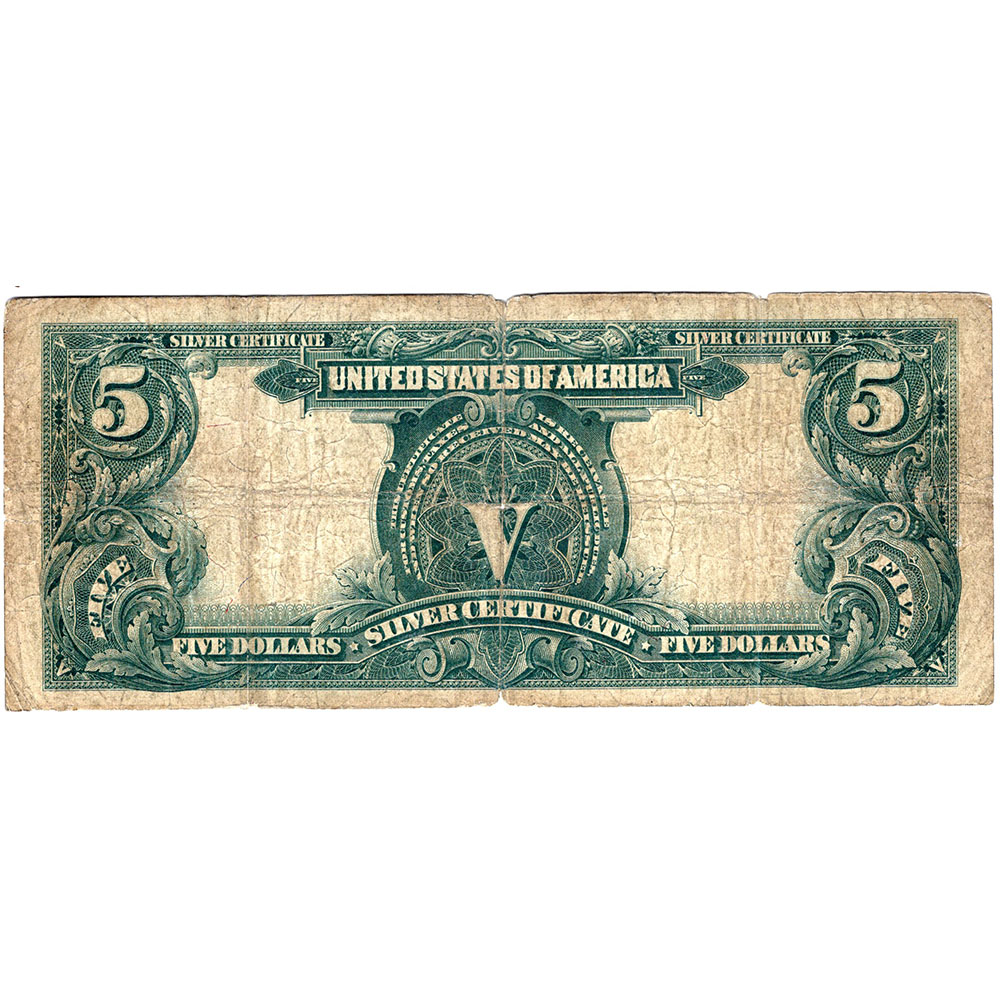
1899 $5 Silver Certificate Indian Good
| Qty | Wire/Check | Bitcoin | CC/Paypal |
| Any | $295.00 | $297.95 | $306.80 |
The 1899 $5 Silver Certificate, commonly known as the “Indian Chief” note, is one of the most iconic pieces of U.S. paper currency ever issued. This note, bearing the portrait of Native American Chief Running Antelope, is instantly recognizable for its bold design and historical importance. Issued during a period when the United States was transitioning from large-size notes to smaller issues, it represents both the artistry of late 19th-century American engraving and the economic reliance on silver as a monetary standard. The note was backed by silver deposits held by the U.S. Treasury, and holders could redeem it for silver dollars on demand. Today, surviving examples are cherished by collectors, with even heavily circulated notes in Good condition remaining desirable due to their striking design and cultural significance.
The history of the 1899 $5 Silver Certificate lies within America’s broader debate over the use of silver and gold as the foundation of its monetary system. Silver Certificates were first authorized by the Bland-Allison Act of 1878, which required the government to purchase large amounts of silver and issue paper money redeemable in silver dollars. By 1899, these notes had become an essential part of U.S. currency in circulation. The $5 denomination was a workhorse of commerce, frequently changing hands in daily trade. This heavy use is one reason why so few examples survive today in high grades. Most were worn out and destroyed, replaced by newer issues as the country approached the 20th century and later transitioned to Federal Reserve Notes.
The design of the 1899 $5 Silver Certificate is both unique and controversial. The obverse features a large central portrait of Chief Running Antelope of the Hunkpapa Lakota Sioux, the only Native American ever depicted as the central figure on U.S. paper money. However, historians have noted that the headdress shown in the engraving was not authentic to Running Antelope’s culture, but rather a composite image modified for aesthetic reasons. Despite this inaccuracy, the portrait has come to symbolize Native American heritage on American currency. Surrounding the portrait are ornate scrollwork and the words “SILVER CERTIFICATE,” “UNITED STATES OF AMERICA,” and the denomination expressed in both words and numerals. The reverse design features an intricate geometric pattern in dark green ink, typical of large-size currency of the era.
The Bureau of Engraving and Printing in Washington, D.C., produced these notes under the authority of the U.S. Treasury. Each note was printed with a distinctive large-size format, measuring approximately 7.375 by 3.125 inches, significantly larger than modern U.S. currency. These oversized notes allowed engravers greater artistic freedom, and the Indian Chief design remains one of the most admired in American currency history. Serial numbers, Treasury seal colors, and signature combinations varied, giving rise to different collectible varieties within the series. All examples, however, were redeemable in silver, linking the paper money directly to tangible precious metal holdings.
The mintage of the 1899 $5 Silver Certificate was substantial, as these notes were meant for active circulation across the country. Millions were printed, but the survival rate today is much lower, especially for notes in collectible condition. Because these notes were issued for everyday use rather than as commemoratives or limited releases, the vast majority were eventually redeemed, destroyed, or worn out through decades of circulation. As a result, the remaining population is skewed heavily toward heavily circulated grades, with high-grade examples commanding significant premiums. Even so, collectors value notes in all conditions because of the enduring popularity of the Indian Chief design.
Condition plays a major role in the desirability and market value of the 1899 $5 Silver Certificate. A note in Good (G) condition, as specified here, shows extensive wear from heavy circulation. The paper will likely be limp, with major folds, tears, small holes, or edge roughness present. Much of the fine detail in the engraving may be faded, and parts of the design could be missing due to wear. Nonetheless, the central portrait of Chief Running Antelope remains identifiable, and the denomination is still clear. While Good condition is considered a lower grade in the paper money world, such notes remain highly collectible because of the historical importance and popularity of the type. Collectors often acquire lower-grade examples as affordable entry points into the world of large-size U.S. currency.
The cultural significance of this note extends beyond numismatics. Chief Running Antelope was a prominent figure among the Lakota Sioux and a diplomat who worked to balance tribal traditions with the pressures of dealing with the U.S. government during the 19th century. His selection for the $5 Silver Certificate was intended to honor Native Americans, though the inaccuracies in the headdress reflect the period’s limited understanding and cultural biases. Nevertheless, the note remains a rare example of Native American representation on federal currency, giving it both historical and symbolic weight in addition to its monetary function.
For collectors, the 1899 $5 Silver Certificate holds enduring appeal. It belongs to the class of “horse blanket” notes, the nickname given to large-size U.S. bills because of their oversized dimensions. Its bold Native American portrait sets it apart from other designs of the era, which often featured politicians, allegorical figures, or simple geometric motifs. Because of its widespread popularity, even well-worn notes remain in demand, and pricing reflects both the condition and the strength of the design. Collectors assembling type sets of U.S. currency or specializing in Silver Certificates almost always seek to include an example of the Indian Chief note.
In terms of investment potential, even lower-grade examples like those in Good condition retain value because of their scarcity and popularity. Unlike more common notes of the same era, the 1899 $5 issue has an almost universal appeal, ensuring steady demand across all collector markets. Higher-grade notes have shown significant appreciation over the years, while Good condition notes provide an affordable yet historically rich option for collectors entering the market. Many collectors view them as cornerstone pieces in a U.S. currency collection, with value derived equally from history, artistry, and symbolism.
In conclusion, the 1899 $5 Silver Certificate Indian Chief note is one of the most iconic issues in American paper money history. Backed by silver, designed with dramatic artistry, and notable for featuring the only Native American portrait used on U.S. currency, it bridges numismatic interest with cultural history. Though an example in Good condition shows extensive wear and lacks the sharp detail of higher-grade notes, it still embodies the full historical significance of the type. Its survival is a testament to its durability and enduring appeal, and it continues to be a prized item among collectors who appreciate both its role in commerce and its unique place in the history of U.S. currency design.


